





What's Happening?
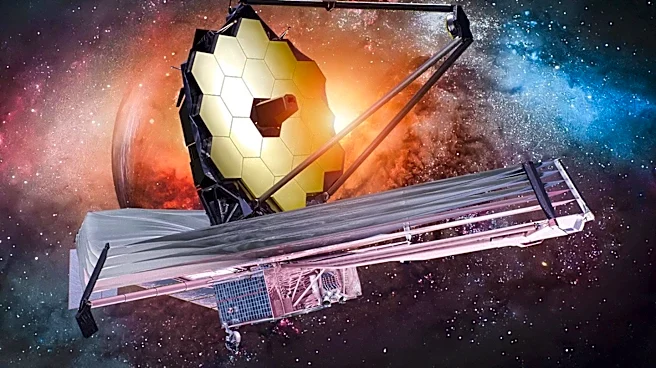
New observations from NASA’s James Webb Space Telescope (JWST) of 72 young, Sun-like stars indicate that the gas necessary for giant planet formation is steadily being swept away from protoplanetary disks. This process, which changes as these young systems
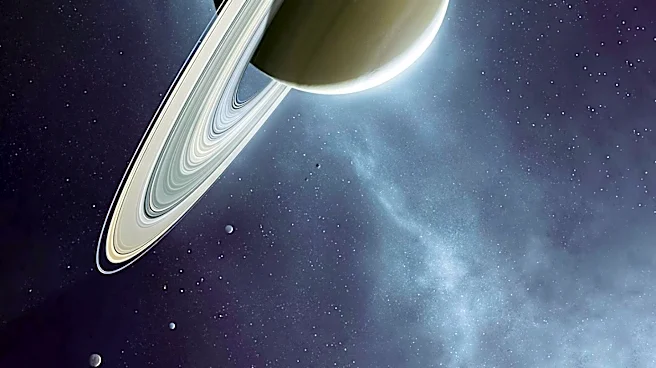
age, suggests that gas giants may have a limited timeframe to form. Planets begin to take shape within these disks of gas and dust, and for gas giants like Jupiter and Saturn, this gas is crucial for building their massive atmospheres. The study, led by Naman Bajaj of the University of Arizona and coauthored by SETI Institute scientist Uma Gorti, utilized archival observations from JWST’s Mid-Infrared Instrument (MIRI) to examine disks at various developmental stages. Researchers tracked two primary indicators of escaping gas: molecular hydrogen, the most abundant molecule in these disks, and ionized neon. Extended molecular hydrogen and ionized neon emission were detected in 66 of the 72 disks, with conical molecular hydrogen winds in 46 systems and fast-moving neon jets in 40. The presence of a neon jet consistently correlated with evidence of molecular hydrogen or oxygen winds.
Why It's Important?
This research is significant for understanding the fundamental timeline of planet formation, particularly for gas giants. The rapid dispersal of gas from protoplanetary disks establishes a critical clock, as the opportunity to form gas-rich planets essentially ends once this gas is gone. The study highlights that planet formation is a race against time, requiring gas giants to accumulate their atmospheres while the disk remains substantial enough to supply the necessary material. The findings demonstrate how the mechanisms responsible for removing gas from these disks evolve over time. Early in a system's life, powerful magnetic winds and jets dominate, but as the system ages and less material falls onto the central star, these forces weaken. Subsequently, atomic gas plays a larger role in outflows, and high-energy radiation from the young star can heat and drive away gas through a process known as photoevaporation. This shift in dispersal mechanisms directly impacts the availability of raw materials for planet building.
What's Next?
The researchers plan to further quantify the amount of gas removed by these winds over time and identify the specific regions within the disks that supply the escaping material. This next phase of research will provide a more detailed understanding of the gas dispersal rates and their implications for planet formation. The study builds upon previous JWST observations from 2024, where Bajaj, Gorti, and their colleagues observed gas being removed from the planet-forming disk around the young star T Cha, focusing on a single system. Expanding on this, future investigations will aim to generalize these findings across a broader range of systems and developmental stages. The continued use of JWST's advanced capabilities will be crucial in unraveling the complex processes that govern the birth and evolution of planetary systems, offering insights into the conditions that lead to the formation of gas giants like those in our own solar system.
Beyond the Headlines
The study's findings have profound implications for exoplanet research and our understanding of planetary habitability. If gas giants have a limited window for formation, it suggests that the conditions and timing within a protoplanetary disk are critical for their existence. This could influence the prevalence of gas giants in other star systems and, by extension, the architecture of those systems. Gas giants are known to play a significant role in shaping the orbits and stability of smaller, rocky planets, potentially affecting their long-term habitability. Understanding the mechanisms and timescales of gas dispersal could refine models of planetary system evolution and help scientists better predict where to look for potentially habitable worlds. The research also validates earlier theoretical predictions regarding molecular winds, showcasing the power of JWST to confirm complex astrophysical phenomena through direct observation, thereby advancing our fundamental knowledge of cosmic processes.