




What's Happening?
Russian forces have launched a renewed drone barrage on Ukraine's Kyiv region, hitting over a dozen apartment buildings and storage depots for a second consecutive day. These aerial attacks, which included small numbers of fast-moving jet-powered drones,
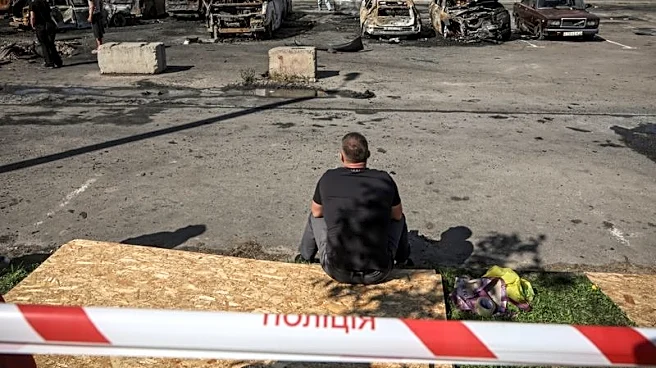
led to prolonged air raids that locked down the Ukrainian capital for 15 hours on Thursday, according to the Foreign Ministry. The strikes have damaged 14 warehouses, 16 private houses, three apartment buildings, and 16 vehicles in the Kyiv region, as reported by Tymur Tkachenko, head of the Kyiv regional military administration. One person was killed and two others were wounded in these attacks. The Russian Defense Ministry claimed to have struck a warehouse storing Ukraine’s Flamingo cruise missiles and fuel for rocket boosters, though Ukrainian officials have not confirmed this. The State Emergency Service noted a 'double tap' tactic, where a second drone hit a location after emergency crews had been deployed, targeting first responders. Air quality in the Kyiv region has also worsened due to the attacks, prompting warnings for residents to stay indoors and keep windows closed.
Why It's Important?
The sustained Russian drone and missile attacks on Kyiv and other Ukrainian regions highlight a deliberate strategy to paralyze the capital's economy and severely disrupt civilian life. The prolonged air raids, lasting up to 15 hours, effectively shut down daily activities, impacting businesses and the general populace. This tactic, described by Andrii Kovalenko of Ukraine’s Center for Countering Disinformation as an attempt to 'exhaust air defenses and the population,' aims to create widespread psychological and economic strain. The targeting of critical infrastructure, including warehouses and the power grid, is part of an annual campaign Ukrainian officials refer to as 'weaponizing winter,' designed to inflict hardship during colder months. The 'double tap' strategy, which targets first responders, poses a significant threat to emergency services and exacerbates the humanitarian impact of the attacks, making rescue and recovery efforts more dangerous and challenging. The damage to commercial infrastructure, such as postal service sorting centers and depots, further disrupts supply chains and economic activity.
What's Next?
Ukrainian officials anticipate continued Russian efforts to 'weaponize winter' through ongoing attacks on critical infrastructure, particularly the power grid. In the southern Kherson region, where glide bombs have already forced a combined heat and power plant to shut down, officials are predicting extended power and heating outages throughout the winter. Consequently, tens of thousands of residents in Kherson are being urged to relocate to safer regions, with authorities offering assistance for evacuation, transportation, resettlement, and social support. Russia is expected to continue its use of various drones, including jet-powered Shahed and Gerbera drones, and smaller attack drones, to target infrastructure and maintain pressure on Ukrainian air defenses and the civilian population. Ukraine, in turn, is likely to persist with its counter-campaign against the Russian oil sector, as evidenced by recent strikes on refineries. The ongoing aerial conflict suggests a prolonged period of heightened alert and disruption for Ukrainian cities, particularly Kyiv, as both sides continue their respective strategies.
Beyond the Headlines
The repeated and prolonged aerial assaults on Kyiv and other Ukrainian cities extend beyond immediate physical damage, aiming to inflict deep psychological and societal costs. The strategy of 'exhausting' the population through continuous air raid alerts and disruptions to daily life can lead to chronic stress, anxiety, and a decline in public morale. The targeting of emergency responders through 'double tap' strikes represents a severe breach of humanitarian norms, undermining the safety of those dedicated to saving lives and further terrorizing the civilian population. The deliberate destruction of commercial infrastructure, including warehouses storing essential goods, not only impacts the economy but also creates shortages and hardships for ordinary citizens, potentially leading to a humanitarian crisis as winter approaches. The call for residents in the Kherson region to evacuate due to anticipated prolonged outages highlights the potential for significant internal displacement and the long-term challenges of rebuilding and restoring normalcy in war-affected areas. These tactics underscore a broader strategy of attrition, seeking to break the will of the Ukrainian people and government through sustained pressure on all fronts.