


What's Happening?
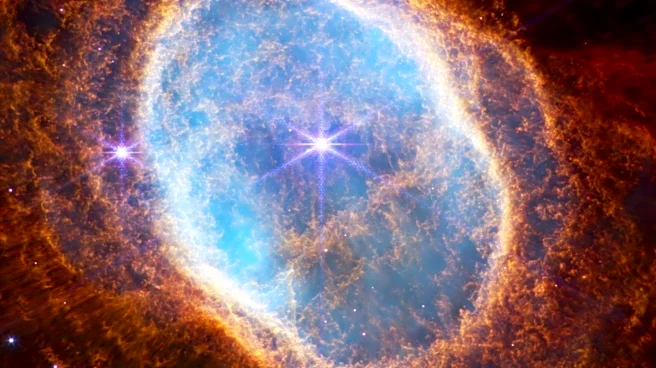
The NASA/ESA James Webb Space Telescope has captured a new image of N159, a turbulent star-forming region located approximately 161,000 light-years away in the Large Magellanic Cloud, a satellite galaxy of the Milky Way. This observation was selected
as Webb’s Picture of the Month for October 2026, coinciding with the Halloween season due to its 'spooky' appearance. Scientists describe the region as a 'cosmic cauldron' where new stars are actively forming within dense clumps of gas. The image reveals the chemistry of the region through its colors: light orange areas indicate polycyclic aromatic hydrocarbons, pale blue gas clouds are ionized hydrogen (H II gas) energized by massive stars, and dark red filaments are cool molecular hydrogen, which shields new stars from harsh radiation and stellar winds. The lower metallicity of N159 compared to the Milky Way offers astronomers a unique opportunity to study star formation under conditions similar to the early universe.
Why It's Important?
This image provides invaluable insights into the processes of star formation in environments with lower metallicity, which are thought to resemble the conditions prevalent in the early universe. By studying N159, astronomers can gain a deeper understanding of how stars formed billions of years ago, shedding light on the origins and evolution of galaxies, including our own. The detailed chemical mapping provided by the James Webb Space Telescope's advanced instruments allows scientists to identify key molecules and gases involved in stellar nurseries, enhancing our knowledge of the complex interplay between gas, dust, and radiation that leads to the birth of stars. This research contributes significantly to fundamental astrophysics and cosmology, helping to refine models of cosmic evolution and the formation of planetary systems.
What's Next?
Astronomers will continue to analyze the data from the James Webb Space Telescope's observations of N159 to further unravel the intricacies of star formation. Future studies may involve comparing N159 with other star-forming regions in different galaxies to understand the variations in stellar birth processes across diverse cosmic environments. The insights gained from N159 could also inform theoretical models of early universe conditions and the initial stages of galaxy assembly. Continued observations with Webb and other advanced telescopes will likely focus on identifying more such regions with unique chemical compositions to build a comprehensive picture of stellar evolution. The public engagement generated by such visually striking images also serves to inspire interest in space exploration and scientific discovery.
Beyond the Headlines
The study of regions like N159 transcends mere astronomical observation; it touches upon fundamental questions about our place in the universe and the conditions necessary for life. Understanding how stars form, especially in environments different from our own galaxy, helps us appreciate the vast diversity of cosmic phenomena. The presence of polycyclic aromatic hydrocarbons, important carbon-based molecules, in these star-forming regions also hints at the potential for complex chemistry in nascent stellar systems, which could have implications for the origins of life. This research contributes to the broader scientific endeavor of understanding the universe's fundamental laws and the processes that govern its evolution, fostering a sense of wonder and encouraging scientific literacy among the general public.