





What's Happening?
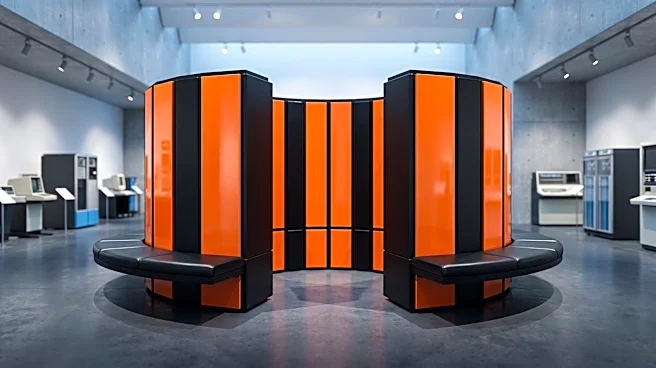
The Museo de Historia de la Computación in Spain has revealed a 1:1 scale visual replica of the iconic 1976 Cray-1 supercomputer. This ambitious project, developed over 18 months, serves as a 50th-anniversary tribute to the original Cray-1 and Apple's
founding. Instead of using cutting-edge technology, the replica is powered by 30 'obsolete' 2012-era Mac Minis. These networked Mac Minis, comprising 64 active processing cores, achieve a combined performance of 1.3 teraflops, significantly surpassing the original Cray-1's peak theoretical performance of 160 megaflops. The system utilizes macOS Mojave (10.14) and its built-in support for MPI (Message Passing Interface) to orchestrate tasks across the cluster. The museum's visitors can observe the system running matrix algorithms in real-time, demonstrating the evolution of computer architecture.
Why It's Important?
This project is important as it highlights the dramatic advancements in computing power and efficiency over the past five decades. The ability to replicate a supercomputer from 1976 using consumer-grade hardware from a decade ago underscores how accessible and powerful modern computing has become. The original Cray-1 was a purpose-built research machine, while its replica demonstrates that similar, if not superior, performance can be achieved through parallel processing with readily available, less expensive components. This initiative also serves as an educational tool, allowing museum-goers to understand the shift from vector processing to distributed, parallel computing architectures. It showcases how 'obsolete' technology can be repurposed creatively to achieve significant computational feats, promoting sustainability and innovative engineering in the tech sector.
What's Next?
The Cray-1 replica is currently operational at the Museo de Historia de la Computación, where it continues to run matrix algorithms for public viewing. The team behind the project may continue to optimize the cluster's performance, potentially aiming to restore the previously achieved 1.5 teraflops with all 70 available cores. The success of this project could inspire other museums and educational institutions to undertake similar initiatives, using readily available hardware to recreate historical computing milestones. This could lead to more interactive and engaging exhibits that demonstrate the evolution of technology in a tangible way. Furthermore, the project's innovative use of passive convection cooling for the Mac Mini cluster could influence future designs for quiet and efficient server environments, particularly in settings where noise reduction is crucial.
Beyond the Headlines
Beyond its immediate educational and historical value, this project subtly challenges the notion of technological obsolescence. By demonstrating that older consumer hardware can be effectively repurposed to create a powerful computing cluster, it encourages a re-evaluation of the lifecycle of electronic devices. This could foster greater interest in upcycling and sustainable practices within the tech community. The project also highlights the ingenuity of engineers and developers in finding creative solutions to complex problems, leveraging existing resources rather than always seeking the newest and most expensive options. It serves as a testament to the enduring principles of computer science, where fundamental concepts like parallel processing can be applied across different generations of hardware to achieve remarkable results.