
What's Happening?
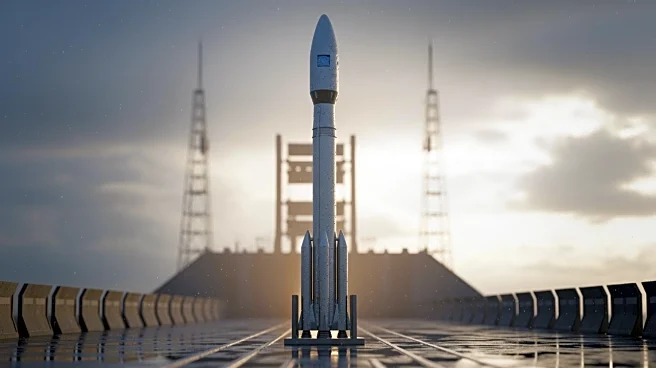
NASA astronaut Chris Williams, currently stationed on the International Space Station (ISS), captured a photograph of the Artemis II Space Launch System (SLS) rocket at launch pad 39B at the Kennedy Space Center in Florida. The photograph was taken as the ISS passed
over Florida shortly after the SLS rocket arrived at the launch pad on January 17, 2026. Williams shared the image on social media, noting the significance of the rocket, which is set to carry four astronauts on a lunar flyby mission as part of NASA's Artemis program. The Artemis II mission, scheduled to launch no earlier than February 6, 2026, will include a crew of Reid Wiseman, Victor Glover, Christina Koch, and Jeremy Hansen. This mission marks a significant step in NASA's plans to return humans to the Moon and eventually conduct missions to Mars.
Why It's Important?
The Artemis II mission represents a pivotal moment in NASA's efforts to resume human exploration of the Moon, a goal not pursued since the Apollo program over 50 years ago. This mission will not only test the capabilities of the SLS and Orion spacecraft but also pave the way for future lunar landings and extended missions on the Moon's surface. The inclusion of diverse crew members, such as Victor Glover, the first person of color to travel beyond low-Earth orbit, and Christina Koch, the first woman, underscores NASA's commitment to diversity and inclusion in space exploration. The success of Artemis II is crucial for the subsequent Artemis III mission, which aims to land astronauts on the Moon's south pole, and for the long-term goal of establishing a sustainable human presence on the Moon as a precursor to Mars exploration.
What's Next?
Following the Artemis II mission, NASA plans to conduct a wet dress rehearsal by February 2, 2026, to ensure the readiness of the SLS and Orion systems. The Artemis III mission, scheduled for 2028, will involve a crewed landing on the Moon's south pole using SpaceX's Starship Human Landing System. This mission will focus on scientific research, including water ice extraction, and will further NASA's understanding of the lunar environment. Additionally, the Artemis program will contribute to the development of the Gateway station, an international and commercial partnership that will support future lunar and deep-space missions. As the ISS approaches its decommissioning in 2030, the Artemis program will play a critical role in maintaining human presence in space and advancing space exploration technologies.