







What's Happening?
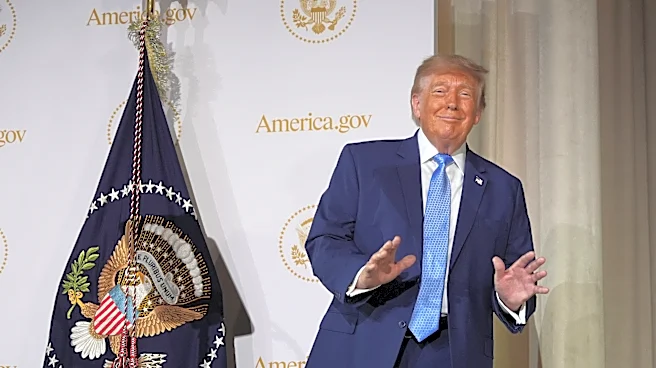
President Trump officially launched America.gov, a new artificial intelligence-powered government website designed to streamline Americans' interactions with federal services. The platform, introduced at the Andrew W. Mellon Auditorium in Washington,
D.C., features a chatbot-style interface that allows users to ask questions about government programs, benefits, and services in plain language. The administration describes America.gov as a 'front door' to federal resources, aiming to consolidate information currently spread across numerous agency websites. President Trump signed an executive order directing federal agencies to integrate their online services with America.gov, envisioning it as a single digital portal for accessing government information and completing transactions. The platform is powered by Google's Gemini and Elon Musk's Grok, and the administration plans to expand its capabilities to include tasks like renewing passports and enrolling in Medicare.
Why It's Important?
The launch of America.gov represents a significant step in the U.S. government's adoption of artificial intelligence for public services. This initiative aims to simplify access to federal information and services, potentially reducing bureaucratic hurdles for millions of Americans. By consolidating information and offering a conversational interface, the platform could enhance user experience and efficiency in navigating government processes. However, the integration of AI into public-facing services also raises critical concerns about accuracy, transparency, and data privacy. Experts have highlighted the need for accountability when AI systems are used to help people access government programs, as errors could have severe consequences for individuals. The administration's emphasis on a 'federated system' where individuals control their data is an attempt to address privacy concerns, but the inherent risks of centralizing access to sensitive information remain a key challenge. The success and security of America.gov could set a precedent for future government technology initiatives and influence public trust in AI-driven services.
What's Next?
Following its launch, the administration plans to continuously expand the capabilities of America.gov. The executive order signed by President Trump mandates federal agencies to integrate their public-facing services with the platform 'as soon as possible.' This integration will eventually allow users to perform a wider range of tasks, such as applying for passports and enrolling in Medicare, with Login.gov being incorporated into the service. The platform will focus on public-facing federal services used by over 100,000 people annually, with exceptions for IRS tax-filing services and certain national security functions. The rollout coincided with a White House gathering of technology executives, including leaders from major AI companies, to discuss AI safety and oversight. President Trump announced that these companies agreed to a voluntary framework for internal and external reviews, with a committee of approximately 10 people overseeing compliance. The administration is expected to name an individual to lead this initiative soon.
Beyond the Headlines
The introduction of America.gov delves into the broader societal implications of artificial intelligence in governance. While promising increased efficiency and accessibility, it also brings to the forefront ethical considerations regarding the role of AI in mediating citizen-government interactions. The potential for algorithmic bias, misinformation, or system failures in critical services could disproportionately affect vulnerable populations. The administration's move to integrate AI into such a fundamental aspect of public life underscores a growing trend towards digital transformation, but also necessitates robust oversight mechanisms and public education to ensure equitable access and trust. The debate over AI's expanding role in public services will likely intensify, touching upon issues of digital literacy, the future of government employment, and the fundamental nature of democratic engagement in an increasingly automated world. The success or failure of America.gov could significantly influence public policy on AI regulation and its application in other sectors.