



What's Happening?
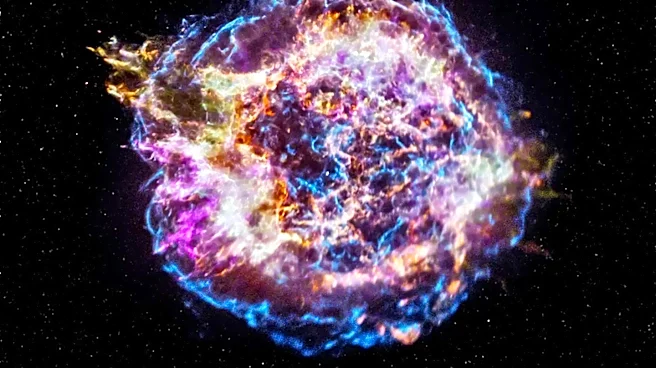
New research published in The Astrophysical Journal Letters indicates that the sun's eventual death could lead to a chaotic upheaval in the outer solar system much sooner than traditional models predicted. Theoretical astrophysicists Konstantin Batygin
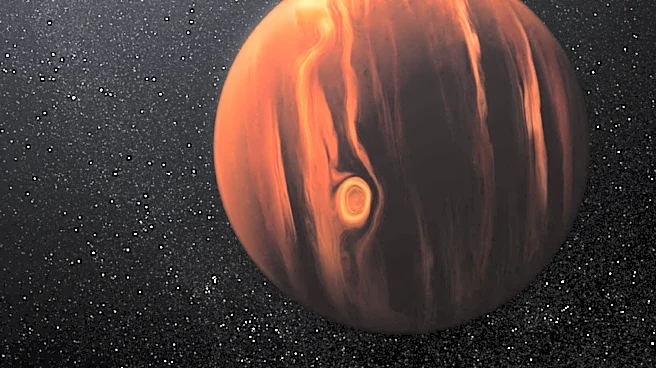
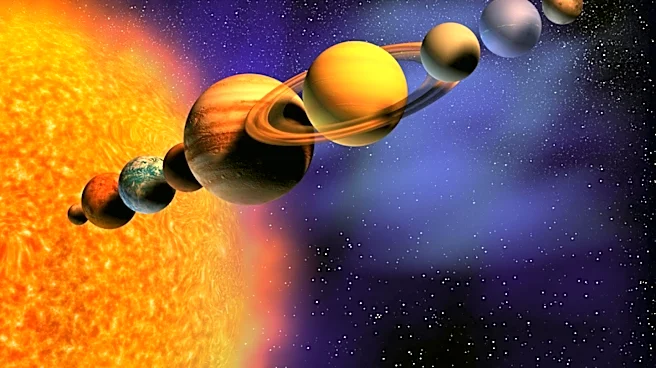
and Jim Fuller at the California Institute of Technology, along with Fred Adams of the University of Michigan, have modeled solar evolution combined with computer programs tracking the orbits of Jupiter, Saturn, Uranus, and Neptune. Their findings suggest that as the sun sheds mass in discrete bursts of stellar material, rather than smoothly, the outer planets could face instability within approximately 1 billion years, a significant reduction from previous estimates of quintillions of years. The study tested 672 burst-driven scenarios, revealing that up to 96% of planetary systems became unstable within 3 billion years of the sun becoming a white dwarf, with about 40% experiencing disruption even earlier.
Why It's Important?
This research significantly alters the understanding of the long-term stability of our solar system. The revised timeline for potential instability in the outer solar system, from quintillions to roughly 1 billion years, has profound implications for astrophysics and planetary science. It challenges established models of stellar evolution and planetary dynamics, suggesting that the process of a star's death is more violent and impactful on its planetary system than previously assumed. The findings could lead to a re-evaluation of how scientists predict the fate of exoplanetary systems as well. Understanding these dynamics is crucial for comprehending the ultimate fate of our own cosmic neighborhood and the broader universe, influencing future research directions in stellar and planetary evolution.
What's Next?
The findings from this study are likely to spur further research into the precise mechanisms of mass loss during a star's death and its effects on planetary orbits. Future investigations may involve more detailed simulations, incorporating additional variables or refining the models of stellar material ejection. Astronomers may also seek observational evidence from other dying star systems to validate or refine these theoretical predictions. The scientific community will likely engage in discussions and debates to integrate these new insights into existing astrophysical theories. This could lead to a more comprehensive understanding of stellar end-of-life processes and their profound impact on the stability and longevity of planetary systems, including our own.
Beyond the Headlines
The study's revelation that the sun's mass loss in 'pieces' rather than smoothly could trigger rapid instability highlights the complex and often unpredictable nature of cosmic phenomena. This detail underscores the limitations of previous simplified models and emphasizes the importance of granular, dynamic simulations in astrophysics. The potential for planets like Uranus and Neptune to swap orbits or be expelled from the solar system paints a dramatic picture of the distant future, illustrating the immense forces at play in stellar evolution. This research also subtly reminds us of the transient nature of even seemingly stable celestial arrangements, offering a humbling perspective on the lifespan of our solar system within the vastness of cosmic time.