


What's Happening?
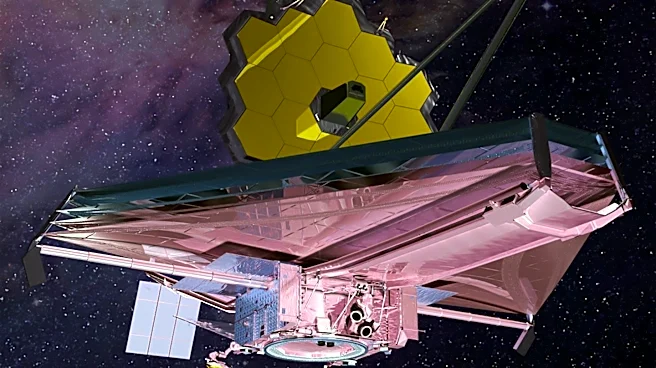
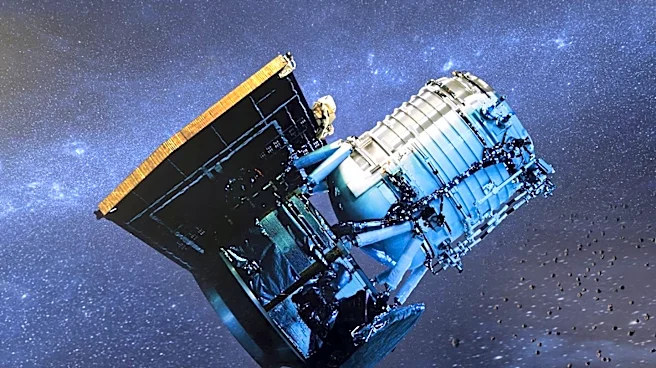
Astronomers have identified a unique astronomical phenomenon involving two supernova remnants, G189.6+3.3 and IC 443, which are believed to have originated from a binary star system. Using data from NASA's Fermi Gamma-ray Space Telescope, researchers
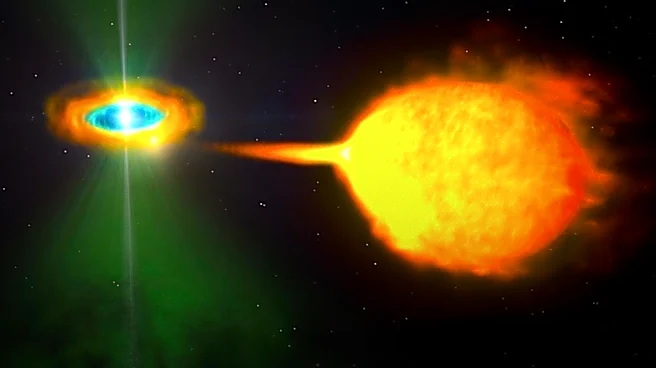
detected high-energy gamma rays from G189.6+3.3, located near the well-known Jellyfish Nebula. The study, published in Nature Communications, suggests that these remnants are not coincidental neighbors but rather the result of two stars that exploded in separate supernovas after orbiting each other for millions of years. The research team, led by Miltiadis Michailidis from Stanford University, found that the northern half of G189.6+3.3 is dominated by accelerated protons due to its interaction with a dense hydrogen gas cloud, while the southern half is dominated by electrons. This discovery provides a real-world system to test theories about massive binary stars and their life cycles.
Why It's Important?
This discovery is significant as it provides the first confirmed case of two supernova remnants linked to the same binary star system, offering a new perspective on stellar evolution and supernova mechanics. Understanding the dynamics of such systems can enhance knowledge about cosmic ray production and the role of binary stars in the universe. The findings could lead to more accurate models of supernova energy release, which has implications for astrophysics and the study of cosmic phenomena. The research also opens avenues for identifying similar systems, potentially reshaping theories about the frequency and nature of binary star supernovas.
What's Next?
The research team plans to search for additional binary supernova remnant pairs in the galaxy to understand why this system is unique. By measuring the distance between explosion centers, astronomers aim to refine estimates of supernova energy release. This ongoing research could lead to breakthroughs in understanding the life cycles of massive stars and the conditions leading to supernova events. The study's findings may also influence future astronomical observations and the development of new technologies for detecting and analyzing cosmic events.