

What's Happening?
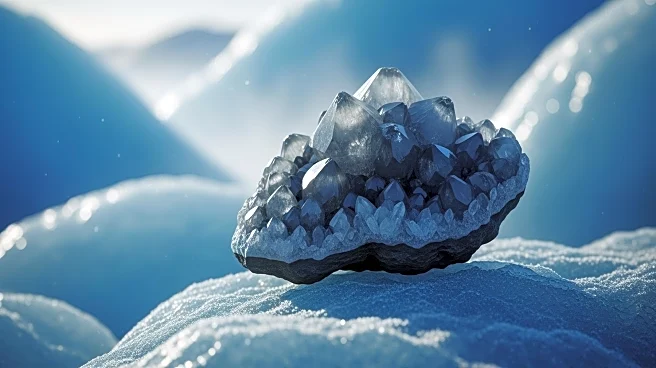
Dalaroo Metals has announced significant findings from its initial exploration at the Blue Lagoon project in Greenland. The exploration, which marks the first sampling effort since 1979, revealed a district-scale system rich in critical minerals such
as zirconium, hafnium, and rare earth elements (REEs) across a 2.7km strike. All 113 samples collected showed anomalous values, indicating a promising new critical metals district. The project identified concentrations exceeding 2% zirconium oxide and 40 parts per million (ppm) hafnium oxide, suggesting a broad and well-mineralized target area. Hafnium, crucial for next-generation microchips and semiconductors, is in high demand due to its advanced chemical properties. The presence of heavy REOs, enriched in dysprosium and terbium, further highlights the potential of this untapped district. Notably, the sampling showed low uranium levels, simplifying processing complexities and meeting Greenland's permitting requirements.
Why It's Important?
The discovery at Blue Lagoon is significant for the global supply of critical minerals, particularly hafnium and rare earth elements, which are essential for high-tech applications. Hafnium's role in microchip production is crucial as it allows for more efficient energy storage and reduced electron leakage, making it a valuable component in the tech industry. The low uranium levels in the samples could streamline the extraction process, reducing environmental and regulatory hurdles. This development positions Dalaroo Metals as a key player in the critical minerals market, potentially impacting global supply chains and technological advancements. The findings could attract further investment and exploration in Greenland, a region with untapped mineral potential.
What's Next?
Dalaroo Metals plans to build on these initial findings with further exploration activities. The next steps include infill sampling, trenching, and shallow drilling to better understand the source and structure of the mineralized zones. These efforts aim to evaluate the continuity and grade distribution of the anomalies. The company has secured full funding for these initiatives following a recent capital raising. The results from these activities will be combined with geological mapping, mineralogical studies, and remote sensing data to refine key target areas. Successful follow-up exploration could lead to the development of a new critical minerals district in Greenland, potentially influencing global markets.