


What's Happening?
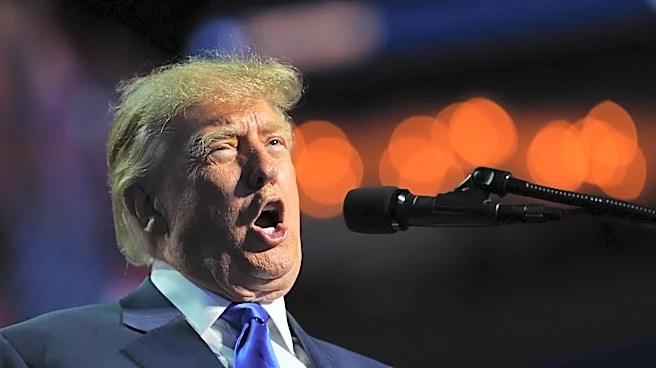
Congresswoman Sydney Kamlager-Dove (D-CA) has voiced strong criticism regarding President Trump's economic priorities and his proposal of a $5,000 dividend to every American adult if Republicans maintain control of Congress. Speaking from Dallas, where
Democrats are counter-programming the Republican midterm convention, Kamlager-Dove labeled the dividend idea a 'bribery scheme' and expressed skepticism about its feasibility and intent. She highlighted that while President Trump acknowledges economic pain, he has not adequately addressed the 'affordability crisis' affecting gas, groceries, housing, and healthcare costs. Kamlager-Dove argued that funds for such a dividend could be available if tax cuts were not disproportionately given to the wealthy, while essential services like healthcare are reduced. She emphasized the need for 'commonsense measures and policies' that protect Social Security and Medicare, and provide tax credits for working families, rather than focusing on 'edifices made in his name' or engaging in economic conflicts like the one with Iran that impact prices.
Why It's Important?
Congresswoman Kamlager-Dove's statements underscore a significant ideological divide in U.S. economic policy and political strategy. Her critique of President Trump's $5,000 dividend proposal as a 'bribery scheme' highlights concerns about the use of federal funds and the potential for such initiatives to be perceived as politically motivated rather than genuine economic relief. This debate is crucial as it touches upon the allocation of taxpayer money, the role of government in addressing economic hardship, and the fairness of the tax system. The focus on the 'affordability crisis' by Democrats, contrasting with President Trump's emphasis on economic gains and specific proposals, sets the stage for key electoral battles. The differing approaches to economic policy, particularly regarding tax cuts for the wealthy versus support for working families, will likely be central to voter decisions, impacting various sectors from energy to healthcare and potentially influencing the legislative agenda for years to come. The discussion also brings to light the broader implications of foreign policy decisions, such as the conflict with Iran, on domestic economic stability and consumer prices.
What's Next?
The debate over economic policy and the proposed $5,000 dividend is expected to intensify as the midterm elections approach. Congresswoman Kamlager-Dove indicated a desire to bring the administration before the House Judiciary Committee to question the 'bribery scheme,' suggesting potential congressional oversight and investigations if Democrats gain more control. The Republican strategy, as outlined by President Trump, aims to rally his base by promising financial incentives and claiming credit for economic successes, despite criticisms regarding the actual state of the economy and rising costs. Democrats, conversely, will likely continue to highlight the 'affordability crisis' and advocate for policies aimed at lowering everyday expenses for Americans, such as protecting social programs and adjusting tax policies. The outcome of these differing approaches will be tested in the upcoming elections, with the public's perception of economic well-being and the effectiveness of proposed solutions playing a critical role in shaping the future political landscape and legislative priorities.
Beyond the Headlines
The discourse surrounding President Trump's economic proposals and Congresswoman Kamlager-Dove's criticisms delves deeper than immediate policy debates, touching upon fundamental questions of governance and public trust. The characterization of a financial incentive as a 'bribery scheme' raises ethical concerns about the integrity of political campaigns and the potential for using public resources for electoral gain. This also reflects a broader struggle over the narrative of economic prosperity and hardship, with each party attempting to define the current economic reality and offer solutions. The emphasis on 'edifices made in his name' versus 'lower prices at the gas station' highlights a clash between symbolic achievements and tangible improvements in daily life for average Americans. Furthermore, the discussion implicitly questions the long-term sustainability and equity of economic policies, particularly the impact of tax cuts on wealth distribution and the funding of social safety nets. This ideological battle over economic philosophy and the role of government in addressing societal needs will continue to shape the political landscape and public discourse, influencing voter behavior and the direction of national policy.