


What's Happening?
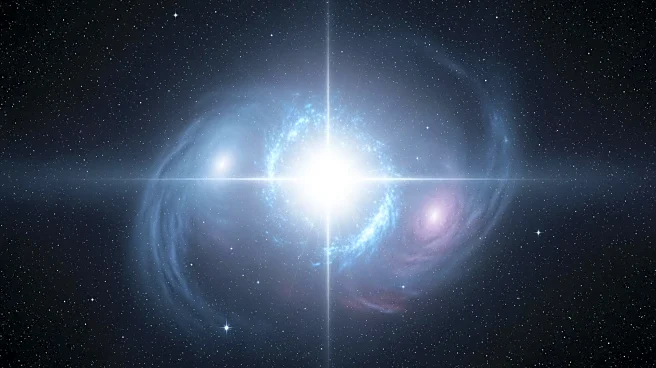
Astronomers have discovered a rare supernova from 10 billion years ago that could provide insights into dark energy, a mysterious force driving the universe's expansion. The supernova's light, amplified by a galaxy's gravity, offers a unique opportunity
to study the universe's growth. Researchers, including Dr. Daniel Perley and Jacob Wise, are analyzing the gravitational lensing effect, which splits the supernova's light into multiple images. This phenomenon allows scientists to measure time delays between images, potentially revealing the universe's expansion rate and offering clues about dark energy.
Why It's Important?
Understanding dark energy is crucial as it constitutes about 68% of the universe and influences its expansion. The discovery of this supernova could help resolve the 'Hubble Tension,' a discrepancy in measurements of the universe's expansion rate. By studying the time delays in the supernova's light, astronomers aim to determine which measurement of the Hubble constant is accurate. This research could significantly advance cosmology, providing a clearer picture of the universe's evolution and the role of dark energy.
What's Next?
The research team plans to conduct precise measurements of the time delays in the supernova's light to better understand the universe's expansion. Observatories worldwide, including the Liverpool Telescope and the James Webb Space Telescope, are involved in this study. Future observations with advanced telescopes could further illuminate the nature of dark energy and its impact on the cosmos. The findings will be published in the journal Astrophysical Letters, contributing to ongoing debates in astrophysics.