






What's Happening?
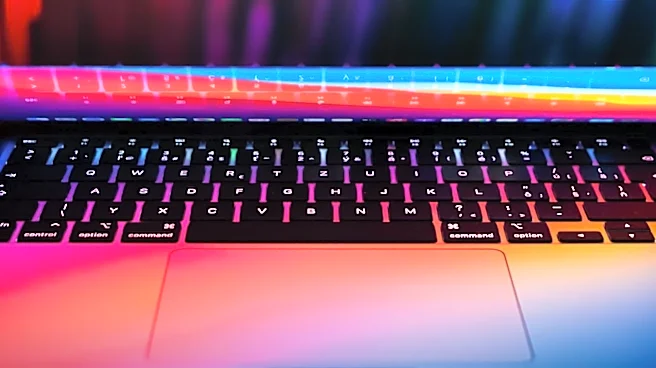
Researchers at IonQ have demonstrated that a standard MacBook Pro, equipped with an Apple M4 Max processor, can effectively decode simulated MegaQuOp-scale quantum workloads. These workloads involved up to 408 logical qubits and over 1 million quantum operations.
The decoding system, designed for proposed trapped-ion quantum computers, added minimal overhead to computation time: less than 0.3% at a two-qubit gate error rate of 0.01%, and under 12% at a 0.05% error rate. This achievement suggests that a single CPU could manage error correction for future fault-tolerant quantum machines. The study, published on arXiv, modeled IonQ’s proposed 'walking cat' trapped-ion architecture, which uses quantum low-density parity-check codes and 'magic-state factories' for T gates. The largest configuration tested involved 11,680 physical qubits and 408 logical qubits, simulating complex workloads like measurement-induced phase transitions and disordered Heisenberg models. The researchers optimized the decoder to update error models dynamically and reduced memory requirements, allowing 12 decoding processes to run concurrently on the MacBook Pro's 12 CPU cores.
Why It's Important?
This research by IonQ is a significant step towards the realization of fault-tolerant quantum computing, addressing a critical challenge in the field: managing quantum error correction efficiently. Fault-tolerant quantum computers require constant monitoring and correction of errors to maintain computational integrity. The ability to perform MegaQuOp-scale decoding on a conventional CPU, such as a MacBook Pro, suggests that the classical control systems for future large-scale quantum computers may not require exotic or highly specialized hardware. This could significantly reduce the complexity and cost of building and operating such machines, accelerating their development and deployment. By demonstrating that decoding can keep pace with quantum hardware with minimal delays, IonQ is paving the way for more reliable and scalable quantum computations. This has profound implications for industries that could benefit from quantum computing, including drug discovery, materials science, and complex optimization problems, by making the technology more accessible and practical.
What's Next?
The findings from IonQ's research, while promising, are based on simulations and a proposed architecture, as MegaQuOp-scale quantum computers do not yet exist. The next steps will likely involve further refining the decoding system and testing it with actual quantum hardware as it becomes available. Researchers will need to validate the simulated error models against real-world noise and operational characteristics of large trapped-ion processors, which may exhibit correlated noise and calibration changes not fully captured in simulations. Future work will also focus on how this classical decoding approach can scale to even larger quantum systems without requiring specialized hardware. The study's success in reducing memory requirements and enabling concurrent decoding processes on a single CPU provides a strong foundation for these future developments. The ultimate goal is to ensure that the classical decoder can continuously interpret error signals from thousands or millions of physical qubits at the same rate as the quantum hardware produces them, preventing computational bottlenecks and enabling truly fault-tolerant quantum operations.
Beyond the Headlines
This research highlights a fundamental interplay between classical and quantum computing, demonstrating that the advancement of quantum technology is not solely dependent on quantum hardware breakthroughs but also on sophisticated classical control and error correction systems. The ability to leverage off-the-shelf classical computing power for complex quantum tasks, such as error decoding, challenges the notion that quantum computing will require entirely new and bespoke infrastructure for every component. This integration of classical and quantum capabilities could lead to hybrid computing architectures where classical processors play a crucial role in managing and optimizing quantum operations. Ethically, the development of fault-tolerant quantum computing raises questions about data security and cryptographic standards, as these machines could potentially break current encryption methods. On a broader societal level, the eventual widespread adoption of fault-tolerant quantum computers could revolutionize various sectors, leading to unprecedented scientific discoveries and technological advancements, but also necessitating new approaches to cybersecurity and data protection.