



What's Happening?
XREAL's Project Aura Android XR glasses are anticipated to launch before the end of 2026, with a price point under $1,500. These glasses aim to integrate the Android experience into the user's physical surroundings, allowing apps and digital content to appear
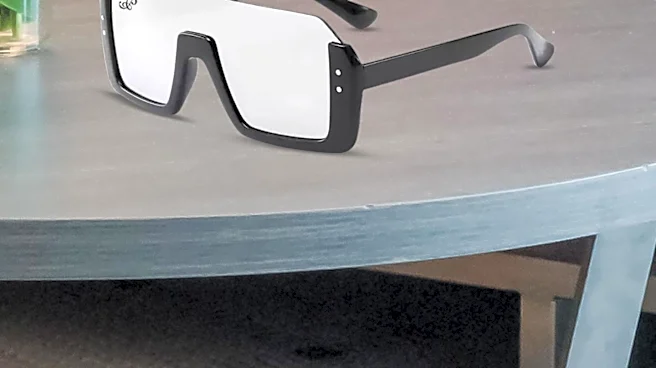
as if suspended in the real world. The device features electrochromic dimming, enabling lenses to darken for immersive digital content while still allowing users to perceive their physical environment. The Aura glasses are a collaborative effort involving XREAL's AR glasses expertise, Google's Android XR platform, and Qualcomm's Snapdragon computing platform, specifically the Snapdragon Reality Elite. The hardware includes Sony Micro OLED displays with a resolution of 1,920 x 1,200 pixels per eye, a 120Hz refresh rate, and a 70-degree field of view, utilizing XREAL's X1S Spatial Coprocessor and X Prism optical system. The glasses support prescription inserts and are designed to offer a natural interaction experience through intuitive hand gestures.
Why It's Important?
The impending launch of XREAL Aura glasses signifies a significant step in the evolution of extended reality (XR) technology, particularly for the Android ecosystem. By bringing the familiar Android experience into a spatial computing format, XREAL, in collaboration with Google and Qualcomm, could democratize XR adoption. This development has the potential to impact various U.S. industries, from entertainment and productivity to navigation and retail, by offering a new modality for content consumption and interaction. The ability to project large virtual displays for media, explore cities via Google Maps with enhanced immersion, and interact with photos in a new way could redefine how individuals engage with digital information. The sub-$1,500 price point aims to make advanced XR more accessible, potentially accelerating market penetration and fostering innovation in app development for spatial computing. This could create new economic opportunities for developers and content creators, while also challenging traditional display manufacturers.
What's Next?
XREAL is expected to announce more details regarding specialized apps and partnerships closer to the launch of the Aura glasses. The company has indicated that the final price will be under $1,500, but the exact figure remains undisclosed. The success of the Aura will heavily depend on app compatibility and the development of applications specifically designed for the XR platform, despite having access to the Google Play Store. Google and Samsung are also actively working on their own Android XR hardware, suggesting a competitive landscape in the near future. This competition could drive further innovation and potentially lead to a wider array of XR devices and experiences. Consumers can anticipate a more elaborate gesture-training sequence upon the initial use of the Aura glasses to ensure a smooth onboarding experience. The market will be watching for how XREAL addresses battery longevity and the user experience with the external compute unit and its connecting cable.
Beyond the Headlines
The XREAL Aura glasses represent a deeper shift towards integrating digital information seamlessly into daily life, moving beyond the confines of traditional screens. This technology raises questions about the future of personal computing and the potential for a more immersive, yet integrated, digital existence. The electrochromic dimming feature highlights a design philosophy that prioritizes user awareness of their physical surroundings, addressing a common concern with fully immersive VR. This balance between digital immersion and real-world presence could set a precedent for future XR devices, emphasizing utility and safety in everyday use. The collaboration between XREAL, Google, and Qualcomm underscores the increasing complexity and interdependency of hardware and software in advanced tech development. This convergence could lead to new ethical considerations regarding data privacy, digital addiction, and the blurring lines between reality and augmented reality, prompting discussions on responsible technology design and usage.