



What's Happening?
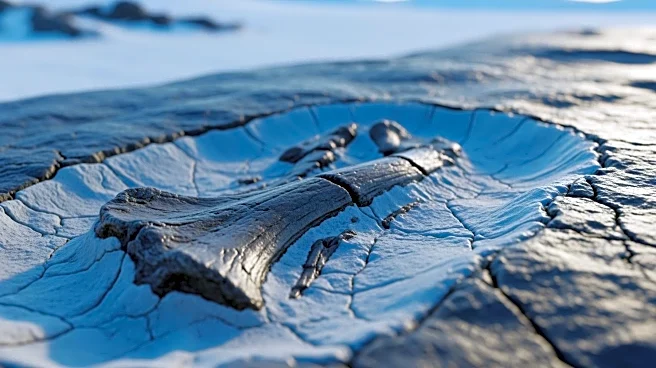
A team of paleontologists has identified a new dinosaur species, Glacialisaurus hammeri, from fossils discovered in Antarctica. The fossils, which include parts of a leg, foot, and ankle, were initially unearthed in the early 1990s by a team led by William
Hammer. The challenging excavation took place on Mount Kirkpatrick, near the Beardmore Glacier, at an elevation of over 13,000 feet. The fossils were encased in dense rock and ice, requiring extensive effort to extract. Recently, researchers Nathan Smith and Diego Pol have classified the remains as a new genus and species, placing Glacialisaurus hammeri within the sauropodomorph group, which includes later giants like Apatosaurus. The discovery highlights the diverse ecosystem that existed in Jurassic Antarctica, as the site also contained remains of other prehistoric creatures.
Why It's Important?
The identification of Glacialisaurus hammeri provides significant insights into the evolutionary history of sauropodomorphs, a group of early dinosaurs. This discovery suggests that these dinosaurs were more widespread than previously thought, even inhabiting the harsh climates of ancient Antarctica. The presence of both primitive and advanced dinosaur species in the same area indicates that evolutionary stages may have overlapped, offering new perspectives on dinosaur evolution. This finding also contributes to our understanding of prehistoric ecosystems, revealing that Antarctica was once capable of supporting a diverse range of species. Such discoveries can reshape scientific theories about dinosaur distribution and adaptation to different environments.