
What's Happening?
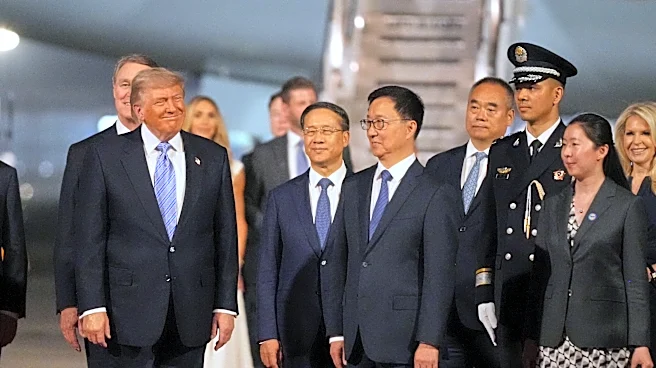
President Trump and Chinese leader Xi Jinping met in Beijing, where Xi emphasized Taiwan as a critical issue in U.S.-China relations. Xi warned that mishandling the Taiwan question could lead to conflict
between the two nations. Taiwan, a self-governing island, is claimed by China, which has not ruled out using force for unification. The U.S. maintains a policy of strategic ambiguity regarding Taiwan's defense, while continuing arms sales to the island. Xi stressed that 'Taiwan independence' and cross-Strait peace are irreconcilable, urging caution from the U.S. to ensure bilateral stability.
Why It's Important?
The Taiwan issue is a significant point of tension in U.S.-China relations, with potential implications for global stability. The U.S.'s strategic ambiguity and arms sales to Taiwan are viewed with hostility by Beijing, which could lead to military confrontations. The stability of the Taiwan Strait is crucial for both nations, impacting economic and geopolitical dynamics. A conflict over Taiwan could disrupt global markets and international relations, affecting stakeholders in both countries and beyond.
What's Next?
Future interactions between the U.S. and China will likely focus on maintaining stability and avoiding escalation over Taiwan. Both nations may engage in diplomatic efforts to manage tensions, with potential discussions on economic cooperation and trade. The U.S. may continue its strategic ambiguity while balancing its support for Taiwan. Observers will watch for any shifts in policy or rhetoric that could signal changes in the bilateral relationship.
Beyond the Headlines
The Taiwan issue highlights broader themes of sovereignty, self-determination, and international law. It raises questions about the balance of power in the Asia-Pacific region and the role of major powers in regional conflicts. The situation also underscores the complexities of U.S.-China relations, where economic interdependence coexists with strategic rivalry.