



What's Happening?
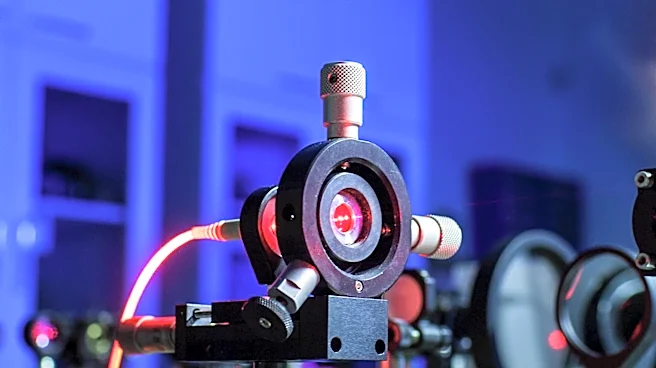
Igor Pikovski, a quantum information scientist at Stevens Institute of Technology, posits that a graviton, the hypothetical particle mediating gravity, will be detected before dark matter. Pikovski is currently developing a prototype graviton detector,
challenging the long-held assumption that detecting a single graviton is impossible due to gravity's weak interaction at quantum scales. He argues that previous calculations were not optimized and that a method exists to extract a single graviton from the 'tsunami' of gravitational waves. This endeavor is significant because the Standard Model of particle physics currently lacks a coherent integration of gravity, a major theoretical gap. While dark matter is also a significant mystery, Pikovski believes the experimental path to graviton detection is more direct and achievable within the next decade or two, contrasting with the ongoing, yet unfruitful, search for dark matter particles.
Why It's Important?
The potential discovery of a graviton would revolutionize physics by finally integrating gravity into the Standard Model, a feat that has eluded scientists for decades. This would provide a unified quantum description of all fundamental forces, leading to a more complete understanding of the universe. Such a breakthrough could validate theories like string theory or 'theories of everything,' which attempt to reconcile quantum mechanics with general relativity. Pikovski's work also highlights the limitations of current artificial intelligence in creative scientific thought, as AI models previously deemed graviton detection impossible. This underscores the continued critical role of human intuition and innovation in pushing the boundaries of scientific discovery, even as AI excels in complex calculations.
What's Next?
Pikovski's prototype graviton detector will undergo further development and testing. If successful, it could pave the way for larger-scale experiments, potentially building upon the infrastructure of existing gravitational wave detectors like LIGO. The scientific community will closely watch for experimental results that could confirm the existence of gravitons. A successful detection would trigger a paradigm shift in theoretical physics, leading to new models and experiments. Conversely, continued challenges in detecting both gravitons and dark matter will necessitate a re-evaluation of current theoretical frameworks and experimental approaches, potentially leading to entirely new avenues of research in fundamental physics.
Beyond the Headlines
The pursuit of the graviton and dark matter delves into the very fabric of reality, exploring the fundamental constituents and forces that govern the universe. The challenge of integrating gravity into quantum mechanics has profound philosophical implications, questioning our understanding of space, time, and matter. The comparison between human creativity and AI's 'conventional wisdom' in this context raises broader questions about the future of scientific discovery and the interplay between human intellect and advanced computational tools. The success or failure of these quests will not only reshape physics but also influence our cosmic perspective, potentially revealing entirely new aspects of existence that are currently beyond our comprehension.