
What's Happening?
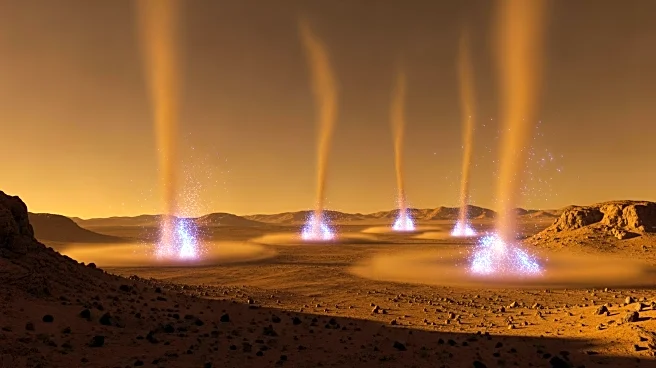
NASA's Perseverance rover has made a groundbreaking discovery on Mars by capturing evidence of electric discharges within dust devils on the planet's surface. This phenomenon, long suspected but never
observed until now, involves lightning discharges occurring in the Martian atmosphere. The dust devils, common on Mars, are whirlwinds created by rapidly rising columns of warm air. The discovery was made using a microphone on the rover's SuperCam instrument, which detected electrical disturbances as dust devils passed over. This finding confirms that lightning can occur on Mars, similar to phenomena observed on other planets like Saturn and Jupiter.
Why It's Important?
The detection of electric dust devils on Mars has significant implications for our understanding of the planet's atmospheric and surface chemistry. Lightning can trigger unique chemical reactions, potentially altering the chemical balance and creating complex compounds, including organic molecules. This discovery enhances our knowledge of Martian weather patterns and could inform future missions and studies aimed at exploring the planet's potential for supporting life. The ability to detect such phenomena also demonstrates the advanced capabilities of the Perseverance rover and its instruments.
Beyond the Headlines
The presence of lightning on Mars raises intriguing questions about the planet's potential to support life. While the conditions on Mars are vastly different from Earth, the occurrence of electric discharges could influence the formation of organic molecules, a key component of life. This discovery may prompt further research into the planet's habitability and the possibility of past or present life forms. Additionally, understanding Martian weather patterns is crucial for the safety and success of future manned missions to the planet.