






What's Happening?
A new study led by the University at Buffalo has found that the site of a former U.S. military base in Greenland, Camp Century, was ice-free approximately 416,000 years ago. During this period, summer temperatures were 4.7 degrees Celsius (8.5 degrees Fahrenheit)
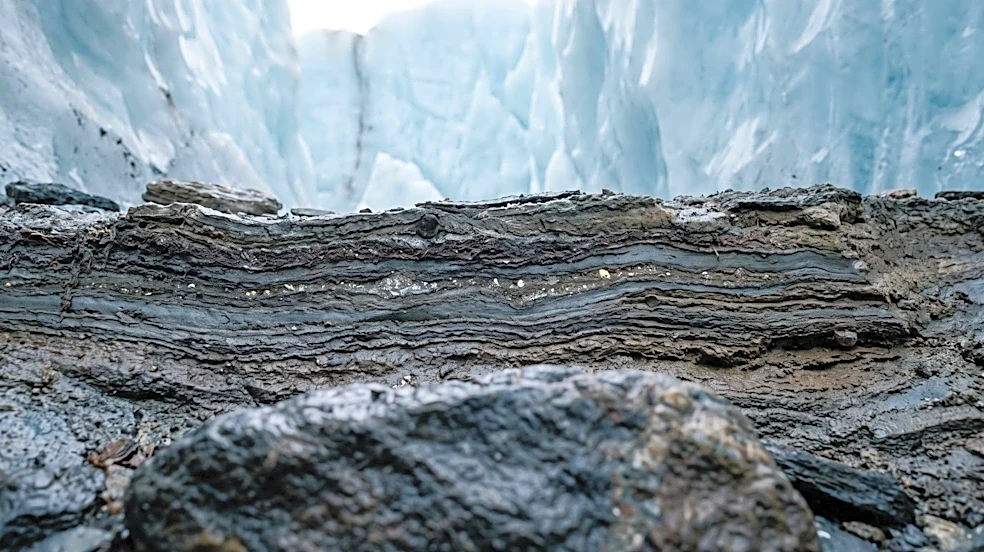
warmer than modern summers. This finding is based on the analysis of ancient sediment recovered from nearly a mile beneath the ice sheet at Camp Century in the 1960s. For the area to have been ice-free, the Greenland Ice Sheet would have had to retreat over 60 miles from its current edge in that region. The research, published in Climate of the Past, utilized fatty molecules produced by bacteria preserved in the sediment to reconstruct past temperatures. This marks the first quantitative estimate of land-based summer temperatures in Greenland during this ancient warm period. The study highlights that the duration of warming may be as crucial as the magnitude of temperature increase, as similarly warm summers 5,000 to 10,000 years ago did not result in an ice-free Camp Century.
Why It's Important?
This study provides critical insights into the Greenland Ice Sheet's response to sustained warming, which has significant implications for future climate projections. The finding that a moderate temperature increase, sustained over tens of thousands of years, led to such a substantial ice sheet retreat underscores the potential long-term impacts of current human-caused warming. Scientists project Arctic temperatures could rise significantly by the end of the century, and this historical data offers a natural analog for understanding potential future scenarios. The research helps refine climate models by providing empirical evidence of past ice sheet behavior under warmer conditions. Understanding the interplay between temperature magnitude and duration is vital for predicting sea-level rise and its global consequences, affecting coastal communities, infrastructure, and ecosystems worldwide. The study also emphasizes that current warming is more intense than the ancient warm period, suggesting potentially more rapid and severe ice sheet responses.
What's Next?
The findings from this University at Buffalo-led study will likely contribute to ongoing discussions and research within the climate science community regarding the stability of the Greenland Ice Sheet. Future research may focus on refining the understanding of the duration of past warm periods and their exact impact on ice sheet dynamics. Scientists will continue to monitor current Arctic warming trends and compare them with historical data to improve predictions of future ice melt and sea-level rise. Policy discussions related to climate change mitigation and adaptation strategies may also draw upon these findings to emphasize the long-term consequences of sustained warming. The study's insights could inform international efforts to reduce greenhouse gas emissions, as the potential for significant ice sheet retreat under prolonged warming becomes clearer. Further analysis of other ancient sediment samples from Greenland could provide additional data points to corroborate and expand upon these findings.
Beyond the Headlines
The study's revelation that Camp Century was ice-free hundreds of thousands of years ago carries profound implications beyond immediate climate predictions. It highlights the deep geological history of climate variability and the Earth's capacity for dramatic environmental shifts, even before human influence. The fact that the sediment samples were recovered from a former U.S. military base, Project Iceworm, adds a layer of historical irony, as a Cold War endeavor inadvertently provided crucial data for understanding future climate challenges. This discovery underscores the interconnectedness of past, present, and future environmental conditions, suggesting that the planet has tipping points that, once crossed, can lead to long-lasting transformations. Ethically, the findings reinforce the urgency of addressing climate change, as the potential for irreversible changes to global ice sheets and sea levels becomes more evident through historical precedent. It also prompts a re-evaluation of the long-term resilience of polar regions to sustained thermal stress.