
What's Happening?
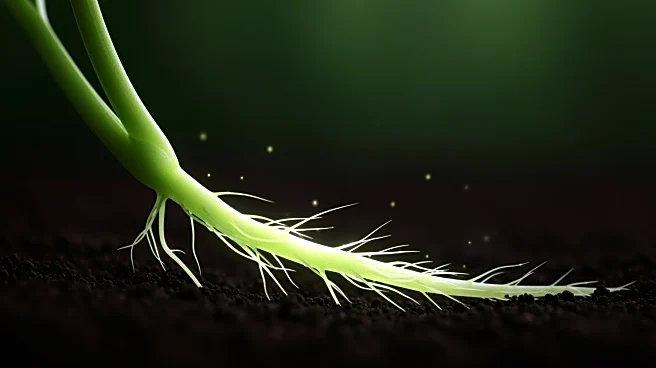
Researchers at Aarhus University, led by professors Kasper Røjkjær Andersen and Simona Radutoiu, have identified a small root mutation that could enable crops to fertilize themselves. This discovery focuses
on the natural nitrogen-fixing ability found in certain plants like peas, clover, and beans, which form symbiotic relationships with bacteria to convert atmospheric nitrogen into a usable form. The team discovered that by altering just two amino acids in a receptor protein, plants can switch from rejecting to cooperating with nitrogen-fixing bacteria. This breakthrough was successfully tested in the plant Lotus japonicus and barley, suggesting potential applications in major crops such as wheat, maize, and rice.
Why It's Important?
This development holds significant implications for agriculture, potentially reducing the reliance on synthetic fertilizers, which are energy-intensive and contribute to CO2 emissions. Currently, synthetic fertilizers account for about two percent of global energy consumption. By enabling major crops to fix nitrogen naturally, this innovation could lead to more sustainable farming practices, lower production costs, and reduced environmental impact. The ability to self-fertilize could transform agricultural practices, particularly in regions where access to fertilizers is limited, thereby enhancing food security and promoting environmental sustainability.
What's Next?
The researchers aim to extend this genetic modification to other cereal crops, which could revolutionize global agriculture. However, further research is needed to identify additional genetic components necessary for successful nitrogen fixation in a broader range of crops. If successful, this could lead to the development of new crop varieties that require less external nitrogen input, significantly impacting global food production and environmental conservation efforts.
Beyond the Headlines
The ethical and ecological implications of genetically modifying crops to self-fertilize are profound. While this technology promises environmental benefits, it also raises questions about biodiversity, the potential for unintended ecological consequences, and the socio-economic impact on farmers reliant on traditional fertilizer markets. The long-term effects on soil health and ecosystem dynamics will need careful monitoring as this technology develops.