
What's Happening?
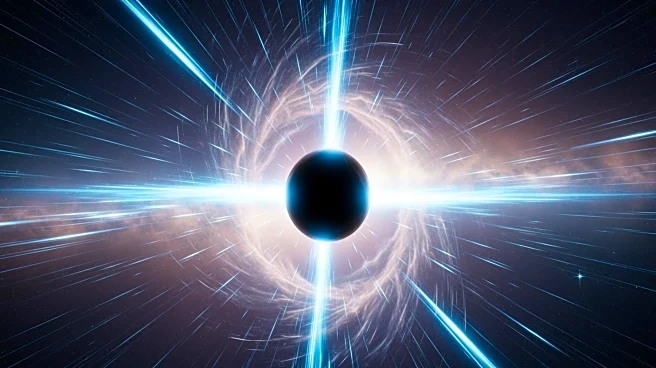
Astronomers have observed a supermassive black hole in the NGC 3783 spiral galaxy, located 135 million light-years from Earth, emitting winds at unprecedented speeds. The black hole, with a mass equivalent
to 30 million suns, caught researchers' attention after a massive X-ray flare. As the flare subsided, it left behind winds traveling at over 37,000 miles per second, or one-fifth the speed of light. This phenomenon was studied by Liyi Gu and his team using the European Space Agency's XMM-Newton and XRISM X-ray space telescopes. The researchers believe the intense X-ray burst and subsequent winds were caused by the black hole's magnetic field suddenly untwisting, a process similar to coronal mass ejections from the sun.
Why It's Important?
This discovery is significant as it provides new insights into the behavior of active galactic nuclei (AGN), the bright regions surrounding supermassive black holes. Understanding these phenomena is crucial for comprehending the evolution of galaxies, as AGNs play a significant role in shaping their environments. The study of such high-speed winds can help scientists learn more about the magnetic properties of AGNs and their influence on galactic development. This research could lead to a deeper understanding of the universe's structure and the forces that govern it.