






What's Happening?
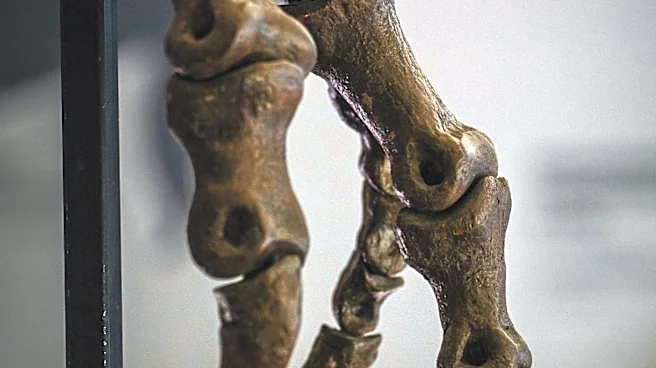
The skeletal fossil of a carnivorous dinosaur, identified as Nanotyrannus and dating back 67 million years, was put up for auction with an estimated price of $6 million to $9 million. This event highlights a growing trend where dinosaur fossils are increasingly
being sold to private collectors for substantial sums. The Nanotyrannus, a smaller relative of the Tyrannosaurus rex, represents a significant paleontological specimen. The auction of such valuable fossils to private hands raises concerns within the scientific community regarding access for research and public display. The high prices commanded by these specimens can make them inaccessible to museums and research institutions, which often operate on limited budgets.
Why It's Important?
The commercialization of dinosaur fossils poses a significant threat to scientific research and public education. When fossils are acquired by private collectors, they often become unavailable for study by paleontologists, hindering the advancement of scientific knowledge about prehistoric life. This lack of access can impede critical research into dinosaur evolution, biology, and ancient ecosystems. Furthermore, private ownership can prevent these unique specimens from being displayed in public museums, thereby limiting educational opportunities for the general public and future generations. The escalating prices at auctions create an uneven playing field, where financial resources, rather than scientific merit, dictate the fate of invaluable natural heritage, potentially leading to a 'lost' scientific record.
What's Next?
The trend of high-value dinosaur fossil auctions is likely to continue, prompting ongoing debate within the paleontological community and among policymakers. Efforts may intensify to advocate for stricter regulations on the sale of scientifically significant fossils, potentially through legislation that prioritizes public and research access. Museums and research institutions may explore new funding models or collaborative initiatives to compete with private buyers. Additionally, there could be a push for international agreements to govern the trade of fossils, especially those found on public lands or deemed part of a shared global heritage. The scientific community will continue to emphasize the importance of fossils as scientific data rather than mere commodities.
Beyond the Headlines
The auctioning of dinosaur fossils for millions of dollars raises profound ethical and philosophical questions about the ownership and stewardship of natural history. It forces a re-evaluation of whether such irreplaceable scientific assets should be treated as private property or as a common heritage of humanity. The debate extends to the very definition of 'value'—is it purely monetary, or does it encompass scientific, educational, and cultural significance? This issue also highlights the broader challenge of balancing private property rights with public interest in scientific discovery and preservation. The long-term implications could include a shift in how paleontological sites are managed and how discoveries are handled, potentially leading to more restrictive policies on commercial excavation and sale to ensure that scientific integrity and public access are maintained.