
What's Happening?
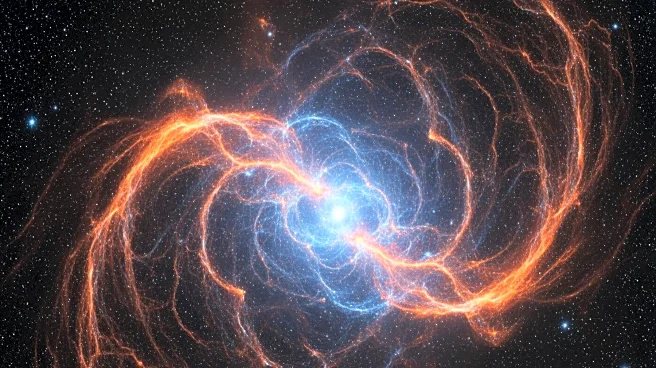
Astronomers have discovered a unique supernova remnant, Pa 30, which defies typical expectations of supernova explosions. Unlike the chaotic debris clouds usually left by supernovae, Pa 30 features long,
straight filaments radiating from a central point. This anomaly has puzzled scientists for years, as it traces back to a 'guest star' observed in 1181 by Chinese and Japanese astronomers. Eric Coughlin from Syracuse University has proposed that the star attempted to explode but did not fully succeed. Instead of a complete detonation, the star's nuclear burning near the surface failed to transition into a full supersonic explosion, leaving a hyper-massive white dwarf at the center. This white dwarf emitted a fast wind enriched with heavy elements, creating the observed filamentary structure.
Why It's Important?
The discovery of Pa 30's unique structure provides new insights into the diversity of stellar explosions and the processes that govern them. This remnant represents a subclass of supernovae known as Type Iax, which are rare but increasingly recognized. Understanding these failed explosions can enhance our knowledge of stellar evolution and the lifecycle of stars. The findings also draw parallels with other astrophysical phenomena, such as tidal disruption events, where similar dense winds might occur. This research not only enriches our understanding of cosmic events but also connects modern scientific modeling with historical astronomical observations, offering a comprehensive view of stellar phenomena.
What's Next?
Future research may focus on identifying other supernova remnants with similar filamentary structures to determine if Pa 30 is truly unique or part of a broader class of stellar phenomena. Astronomers might also explore the implications of these findings for other cosmic events involving dense winds, such as those occurring near black holes. Continued study of Pa 30 could lead to a deeper understanding of the conditions that lead to such failed explosions and their role in the broader context of the universe's evolution.
Beyond the Headlines
The study of Pa 30 highlights the importance of integrating historical astronomical records with modern scientific techniques. This approach not only validates historical observations but also provides a richer context for understanding cosmic events. The research underscores the complexity of stellar explosions and the potential for unexpected outcomes, challenging existing models and prompting a reevaluation of how stars end their life cycles. The aesthetic beauty of Pa 30's structure also serves as a reminder of the intricate and often surprising nature of the universe.