

What's Happening?
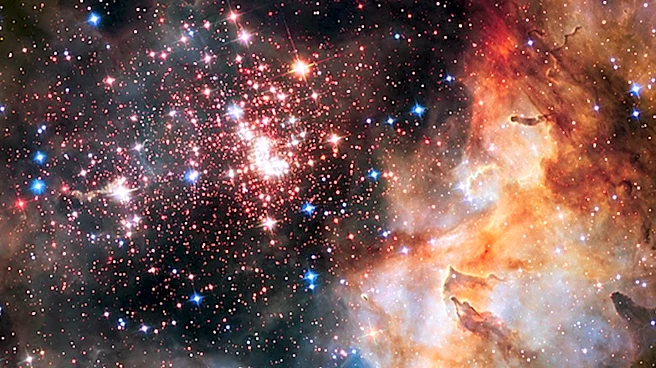
The James Webb Space Telescope has captured a new image of a cosmic feature known as the 'Treasure Chest' within the Carina Nebula, located approximately 7,500 light-years from Earth. This feature is a cometary globule, an isolated cloud of gas and dust
with a dense head and a sweeping tail. The 'Treasure Chest' contains a compact cluster of young stars, estimated to be around 1.3 million years old. The cluster includes about 70 stars, with the most massive being a rare O-type star, 19 times the mass of the Sun. The stars are still embedded within the dusty clouds, and many are surrounded by circumstellar discs. Over time, the starlight will dissipate the surrounding dust, revealing the entire cluster.
Why It's Important?
The discovery and study of the 'Treasure Chest' provide significant insights into the formation and evolution of young stars. Understanding how these stars collect and expel gas from their environment can offer clues about the early stages of star development. The James Webb Space Telescope's ability to capture such detailed images through cosmic dust marks a significant advancement in astronomical observation, enhancing our understanding of stellar nurseries. This research contributes to the broader field of astrophysics by offering a glimpse into the processes that govern star formation and the dynamics within nebulae.
What's Next?
As the James Webb Space Telescope continues its mission, further observations of the Carina Nebula and other regions will likely yield more discoveries about star formation and the lifecycle of stars. Scientists will continue to analyze the data to understand the interactions between young stars and their environments. The ongoing study of the 'Treasure Chest' and similar features will help refine models of stellar evolution and improve predictions about the future of such star clusters.
Beyond the Headlines
The 'Treasure Chest' is located near the Eta Carinae star system, one of the most luminous objects in the Carina Nebula. This proximity may influence the dynamics within the 'Treasure Chest,' offering a unique opportunity to study the gravitational effects of massive stars on nearby star clusters. The findings could have implications for understanding the role of massive stars in shaping their surrounding environments and influencing star formation processes.