






What's Happening?
A recent study utilizing data from NASA's Fermi Gamma-ray Space Telescope has provided new insights into the origins of two supernova remnants located approximately 6,000 light-years away. The study focuses on a binary star system where one star exploded
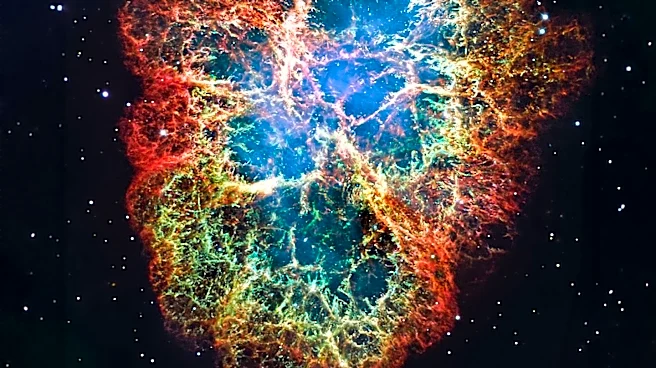
as a supernova, subsequently causing its companion to also explode. This sequence of events resulted in the creation of two overlapping supernova remnants. The younger remnant, known as the Jellyfish Nebula, is prominently visible in the center of the image, primarily in yellow. The older remnant, identified as G189.6+3.3, is depicted in purple. The image combines visible, ultraviolet, and infrared light to illustrate these cosmic phenomena. The study highlights the complex interactions and outcomes when stars in a binary system undergo supernova explosions.
Why It's Important?
This discovery is significant as it enhances the understanding of stellar evolution and the dynamics within binary star systems. By studying these supernova remnants, astronomers can gain insights into the life cycles of stars and the processes that lead to their explosive ends. The findings also contribute to the broader field of astrophysics by providing empirical data that can be used to refine models of supernova behavior and their impact on surrounding environments. This research underscores the importance of space telescopes like NASA's Fermi Gamma-ray Space Telescope in advancing knowledge about the universe and its complex phenomena.
What's Next?
Future research may focus on further analyzing the data collected from these supernova remnants to explore the chemical composition and energy distribution within the remnants. Additionally, astronomers may use this information to study other binary systems and predict potential supernova events. Continued observation and analysis could lead to a deeper understanding of the role supernovae play in the formation of new stars and the distribution of elements across the galaxy.
Beyond the Headlines
The study of supernova remnants not only provides insights into stellar life cycles but also has implications for understanding the origins of cosmic rays and their influence on the interstellar medium. These remnants serve as laboratories for studying high-energy processes and the synthesis of heavy elements, which are crucial for the formation of planets and life. The research also highlights the interconnectedness of cosmic events and their long-term impact on the universe.