




What's Happening?
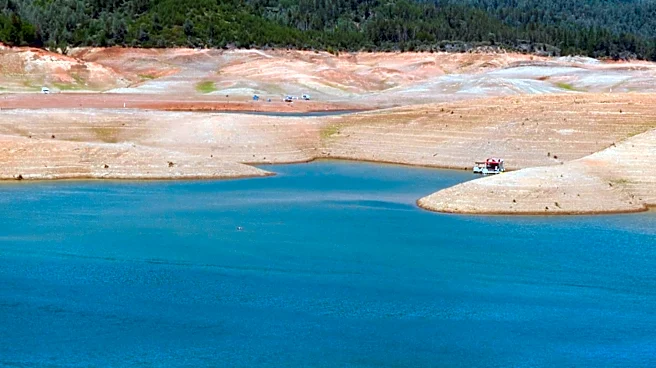
A new study published in the Proceedings of the National Academy of Sciences of the United States of America has revealed that the 2020–2022 drought in California, coupled with excessive groundwater pumping, has caused irreversible damage to some aquifers
in the Sacramento Valley. Satellite data showed an abrupt decline in the aquifers' ability to recharge. Specifically, parts of the Sacramento Valley subsided at rates up to 30 centimeters per year during the drought, leading to a permanent collapse of the pore space within the aquifer's sediment. This structural deformation means these aquifers have lost their capacity to store water and recharge effectively in the future, even with subsequent heavy precipitation events. The study is the first to capture this type of aquifer collapse with high-resolution satellite data.
Why It's Important?
The irreversible damage to Sacramento Valley aquifers has profound implications for California's long-term water security and environmental stability. The loss of water storage capacity in these aquifers means less available groundwater for future generations, which is critical for agriculture, urban supply, and ecosystem health in a drought-prone state. This also increases flood risk, as the ground's reduced ability to absorb precipitation can exacerbate surface water runoff during heavy rain events. The findings challenge existing groundwater management strategies, particularly the classification of the Sacramento Valley's aquifers under the Sustainable Groundwater Management Act (SGMA), suggesting a need for stricter protections similar to those in the critically overdrafted San Joaquin Valley. This situation could lead to increased water costs, agricultural challenges, and potential land subsidence issues affecting infrastructure.
What's Next?
The study's findings are expected to prompt a re-evaluation of groundwater management policies in California, particularly concerning the Sacramento Valley. Researchers, including lead author Stacy Larochelle, suggest that the Sacramento Valley's aquifers may need additional protections and a re-designation under the Sustainable Groundwater Management Act (SGMA). This could lead to stricter regulations on groundwater pumping in the region. The use of satellite data for real-time monitoring offers a new tool for early warning systems, potentially allowing communities to adjust pumping practices before irreversible damage occurs. Further research is needed to fully understand the long-term impacts and to develop effective mitigation and adaptation strategies for water resource management in the face of climate change and increasing water demand.
Beyond the Headlines
The irreversible damage to California's aquifers highlights a critical environmental and ethical dilemma: balancing immediate human needs for water with the long-term sustainability of natural resources. This situation underscores the concept of 'peak water' and the potential for human activities to permanently alter geological structures. The reliance on satellite data for monitoring also signifies a growing trend in environmental science, where advanced technology provides unprecedented insights into complex ecological processes. Ethically, the findings raise questions about intergenerational equity, as current water usage patterns are diminishing resources for future populations. Culturally, it may shift public perception of water as an infinite resource, fostering a greater appreciation for conservation and sustainable practices in a region already grappling with water scarcity.