






What's Happening?
American sculptor Ursula von Rydingsvard passed away at her Manhattan home on October 27, 2026, at the age of 84. Her death was attributed to Alzheimer's disease, as confirmed by her studio manager, Courtney Childress. Von Rydingsvard was celebrated for
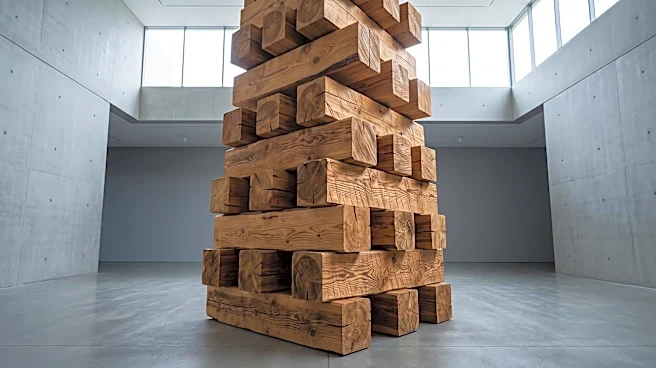
her five-decade-long practice of transforming standardized cedar beams into psychologically charged monumental sculptures. Her work, characterized by repeated beams, modular construction, large scale, and serial accumulation, maintained a vocabulary reminiscent of Minimalism, yet her distinctive saw cuts rejected its smooth finish and apparent impersonality. This tension positioned her work within the broader context of Post-Minimalism. Her career included 13 solo exhibitions across New York, Paris, and Zurich locations of Galerie Lelong, her representative for over three decades. Notably, she continued to exhibit new cedar sculptures and drawings in the year of her passing, demonstrating her sustained artistic activity and evolution.
Why It's Important?
Ursula von Rydingsvard's contribution to American art is significant for her unique approach to sculpture, particularly her use of cedar. Her work challenged and expanded the definitions of Minimalism and Post-Minimalism, offering a more humanizing and tactile dimension to the often austere aesthetic of the former. By employing industrial materials like four-by-four cedar beams and subjecting them to a process that registered touch, strain, and revision, she created pieces that felt both engineered and deeply bodily. This artistic method influenced subsequent generations of sculptors and contributed to a richer understanding of how materials can convey memory and emotion. Her ability to maintain an active and experimental practice late in life, including a commission that reimagined a cedar piece in bronze, highlights her continuous artistic exploration and willingness to evolve, leaving a lasting impact on the discourse surrounding material and form in contemporary sculpture.
What's Next?
The recent bronze reworking of her 1988–89 installation, 'Begin Again: Untitled,' at Laumeier Sculpture Park, which is scheduled to remain on view through August 27, 2028, signifies a potential shift in the perception of her material legacy. This late decision to translate a perishable cedar element into a durable bronze object complicates the familiar description of von Rydingsvard primarily as a cedar sculptor. It suggests a new avenue for interpreting her work, where bronze could carry the 'skin' of her carved surfaces into public spaces with greater longevity. The future will likely involve further analysis of this bronze piece and its implications for her overall oeuvre. Additionally, the disposition of her Brooklyn studio archive and any unfinished works remains an open question, which will be crucial for scholars and institutions seeking to preserve and study her artistic contributions.
Beyond the Headlines
Beyond her artistic output, Ursula von Rydingsvard's life story, marked by her experiences as a child of Polish and Ukrainian parents who were forced laborers during World War II and later lived in displaced persons camps before immigrating to the U.S., deeply informed her artistic sensibility. Her connection to wood, stemming from the raw wooden structures of the barracks and Polish villages, became a profound source for her work, even as her mature pieces remained abstract. This personal history imbues her sculptures with a layer of unspoken narrative and resilience, inviting viewers to consider themes of memory, displacement, and the human condition. Her work serves as a powerful example of how personal history can be transmuted into universal artistic expression, offering a deeper, less obvious implication of the emotional and psychological weight that materials can carry.