

What's Happening?
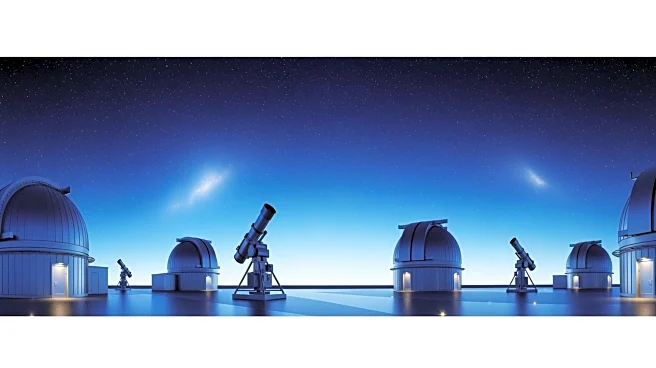
Schmidt Sciences, funded by former Google CEO Eric Schmidt and his wife Wendy, has announced the development of four new observatories, including a space-based telescope with a mirror rivaling those of the Hubble and Roman space telescopes. The observatories, part
of the Schmidt Observatory System, are set to be operational by 2029. They include the Deep Synoptic Array, the Argus Array, the Large Fiber Array Spectroscopic Telescope, and the Lazuli Space Telescope. These facilities aim to advance fields such as exoplanet science and cosmology, with data from all four expected to be publicly available.
Why It's Important?
The introduction of these observatories represents a significant investment in astronomical research, potentially accelerating discoveries in key areas of space science. By providing new tools for observing the universe, Schmidt Sciences is contributing to the advancement of knowledge about exoplanets, black holes, and cosmic phenomena. The initiative also highlights the growing role of private funding in supporting large-scale scientific projects, complementing traditional government-funded research efforts.
What's Next?
The observatories are expected to begin operations within the next few years, with some targeting earlier dates for first light. The data collected will be made available to the scientific community, fostering collaboration and further research. The success of these projects could inspire additional private investments in scientific research, potentially leading to more breakthroughs in our understanding of the universe. The observatories will also serve as a platform for testing new technologies and methodologies in astronomical observation.