
What's Happening?
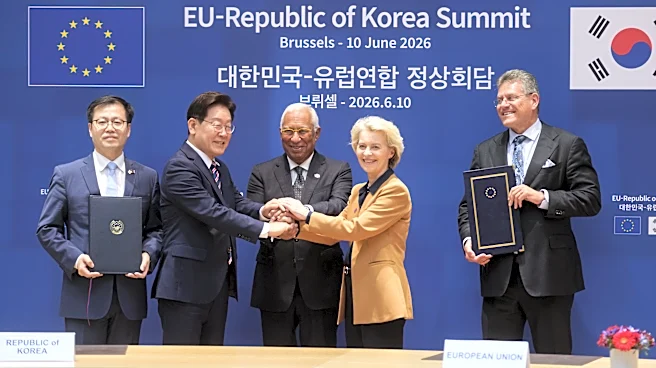
South Korea and Egypt have elevated their bilateral relations to a Strategic Partnership following a summit in Seoul. This development, marked by the issuance of a Joint Statement, aims to translate previous
agreements into tangible outcomes for both populations. The two nations made significant progress in five major areas and signed or revised a total of 12 cooperation documents. Key agreements include launching negotiations for a Korea–Egypt Comprehensive Economic Partnership Agreement (CEPA), signing an Agreement on Social Insurance, and MOUs on Shipbuilding Cooperation, Clean Energy, Electric Power Infrastructure, and Information and Communications Technology (ICT). This summit follows a visit by the South Korean President to Egypt last year, marking the 30th anniversary of diplomatic relations.
Why It's Important?
This strategic partnership signifies a deepening of economic, technological, and cultural ties between South Korea and Egypt, two key players in their respective regions. For the U.S., this development has several implications. Economically, increased cooperation between South Korea, a major U.S. ally and technological powerhouse, and Egypt, a significant U.S. partner in the Middle East and Africa, could influence regional trade dynamics and supply chains. Technologically, collaboration in areas like AI, high-speed internet, and cybersecurity aligns with global digital transformation trends, potentially impacting U.S. tech companies operating in these markets. Politically, strengthening ties between these nations could contribute to regional stability, which is a U.S. foreign policy objective, but also potentially shift geopolitical alignments or influence U.S. diplomatic efforts in the Middle East and Africa. The focus on clean energy and eco-friendly shipbuilding also reflects global priorities that the U.S. shares.
What's Next?
Negotiations for the Korea–Egypt Comprehensive Economic Partnership Agreement (CEPA) are expected to proceed, aiming for an early conclusion to expand bilateral trade and investment. The signed MOUs will lead to concrete projects in shipbuilding, clean energy, electric power infrastructure, and ICT, fostering technological transfer and industrial development in Egypt. The Agreement on Social Insurance will ease burdens on workers and companies, encouraging further business expansion. Additionally, 2027 has been designated as the 'Year of Cultural Exchange between Korea and Egypt,' promoting people-to-people exchanges. Cooperation in defense and the defense industry, building on the success of K9 self-propelled howitzers, is also set to expand, potentially involving joint production and strengthening Egypt's military capabilities.
Beyond the Headlines
The elevation to a Strategic Partnership reflects a broader trend of South Korea expanding its global influence beyond traditional alliances, particularly in emerging markets. This move aligns with South Korea's 'K-Initiative' visions, including a 'Global AI Universal Basic Society' and a 'Green Transformation,' positioning it as a leader in future-oriented industries. For Egypt, the partnership offers access to advanced technology, investment, and expertise, crucial for its economic diversification and modernization efforts. The emphasis on cultural exchange and education also highlights the soft power dimension of international relations, fostering mutual understanding and long-term diplomatic ties. This partnership could serve as a model for South Korea's engagement with other developing nations, further solidifying its role as a significant global actor.