



What's Happening?
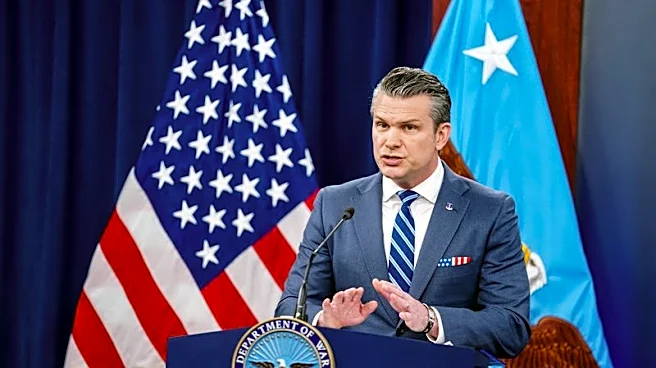
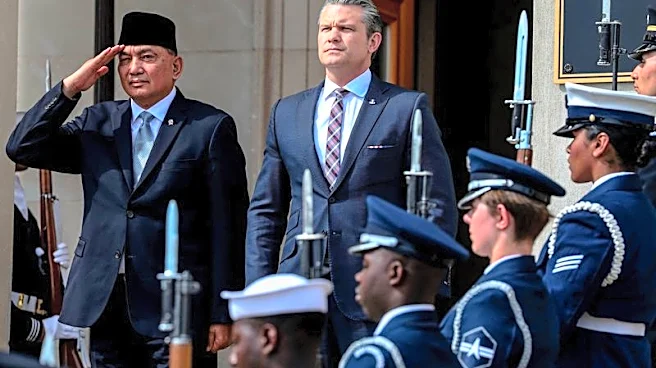
A viral video featuring Defense Secretary Pete Hegseth has sparked widespread discussion after he delivered a prayer at the Pentagon that closely resembles a monologue from the film 'Pulp Fiction.' The video, which has gained significant traction on social
media, shows Hegseth speaking during what appears to be a faith-based gathering at the Pentagon. In his remarks, Hegseth recounts a prayer shared with him by a military planner involved in a Combat Search and Rescue mission, which he refers to as 'CSAR 25:17.' This passage mirrors the famous Ezekiel 25:17 monologue delivered by Samuel L. Jackson's character in the 1994 film. The adaptation includes military-specific language, replacing biblical references with terms like 'downed aviator' and 'camaraderie and duty.' The video has been widely shared, with some versions placing Hegseth's remarks side by side with the film scene, highlighting the similarities.
Why It's Important?
The video has ignited a debate over the appropriateness of using a fictionalized and violent monologue in a formal setting, particularly within the Department of Defense. The blending of religious language with military terminology has drawn mixed reactions online. Some view it as an intentional cultural reference or rhetorical adaptation for a military audience, while others criticize it for its potential insensitivity. This incident highlights the broader issue of how religious imagery and language are used in political and military contexts, a topic that has been under scrutiny recently. The video also underscores the rapid spread and reinterpretation of official moments once they enter the social media landscape, raising questions about the intent and impact of such communications.
What's Next?
The Department of Defense has not yet provided additional context or clarification regarding the remarks, leaving the intent behind Hegseth's prayer open to interpretation. As the video continues to circulate online, it may prompt further discussion and analysis of the use of cultural references in military and political communications. The incident could lead to increased scrutiny of how religious and cultural symbols are employed in official settings, potentially influencing future guidelines or policies within the Department of Defense.