





What's Happening?
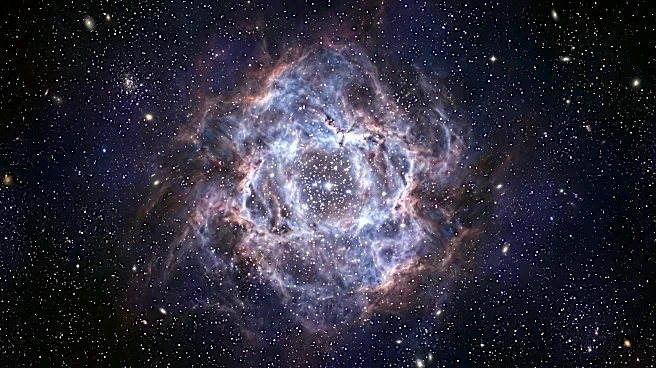
Researchers at the University of Ottawa have introduced an alternative theory for the universe's origin, suggesting it is 26.7 billion years old, significantly older than the widely accepted 13.8 billion years. This theory, named covarying coupling constants
plus tired light (CCC+TL), proposes that fundamental constants governing physical interactions change over cosmic time. These changes, according to the researchers, could explain phenomena currently attributed to dark matter and dark energy, thereby eliminating the need for these hypothetical components. The CCC+TL model has successfully passed a crucial test related to Big Bang nucleosynthesis (BBN), the process that formed the first light elements in the early universe. By modifying the Kawano/NUC123 computer code to incorporate the CCC+TL model's scaling parameters, the researchers found that the predicted abundances of light elements were nearly identical to those of the standard model, indicating consistency with early universe observations.
Why It's Important?
This research presents a significant challenge to the prevailing Lambda-Cold Dark Matter (ΛCDM) model, which forms the bedrock of modern cosmology. If the CCC+TL model proves robust, it could lead to a fundamental re-evaluation of our understanding of the universe's age, composition, and evolution. The potential to explain cosmic observations without invoking dark matter and dark energy, which have eluded direct detection, would simplify cosmological models and potentially open new avenues for theoretical physics. The ability of the CCC+TL model to reproduce the results of Big Bang nucleosynthesis, a cornerstone of the standard model, lends it considerable credibility. This development could influence future astronomical observations and experimental designs, as scientists might shift focus from searching for dark matter to exploring the variability of fundamental constants. It also highlights the dynamic and evolving nature of scientific understanding, where established paradigms are continually tested and refined.
What's Next?
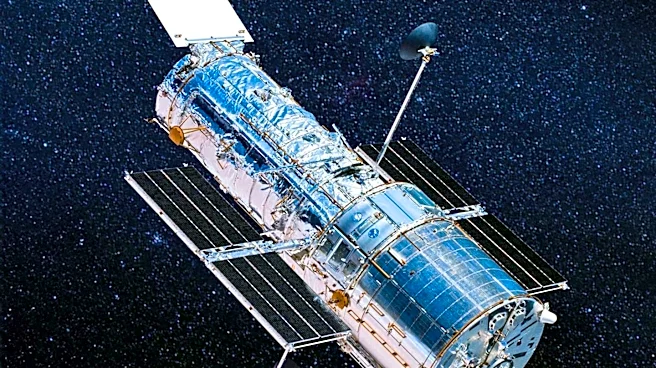
While the CCC+TL model has passed the Big Bang nucleosynthesis test, the researchers acknowledge that the assumption of changing fundamental constants requires stronger physical justification. Further research will involve testing the model against a broader range of cosmological observations, including the cosmic microwave background. The success of this model could encourage astronomers to seriously consider its implications, despite its complexity. The James Webb Space Telescope's ongoing observations of early galaxies will be critical in validating or refuting the CCC+TL model's predictions, as an older universe would provide more time for these galaxies to form and mature. The scientific community will be looking for additional evidence and theoretical developments to either solidify this alternative view or reinforce the existing ΛCDM framework.
Beyond the Headlines
The emergence of the CCC+TL model reflects a growing trend in cosmology to explore alternatives to the standard model, particularly in light of persistent anomalies and the non-detection of dark matter and dark energy. This intellectual pursuit challenges scientists to think beyond established frameworks and consider novel explanations for cosmic phenomena. The debate between these models touches upon the very nature of scientific progress, where new theories must not only explain existing observations but also make testable predictions. If the CCC+TL model gains wider acceptance, it could lead to a re-evaluation of the fundamental constants of nature, potentially impacting other areas of physics. This ongoing scientific inquiry underscores the human drive to understand the universe's deepest mysteries, pushing the boundaries of knowledge and challenging conventional wisdom.