



What's Happening?
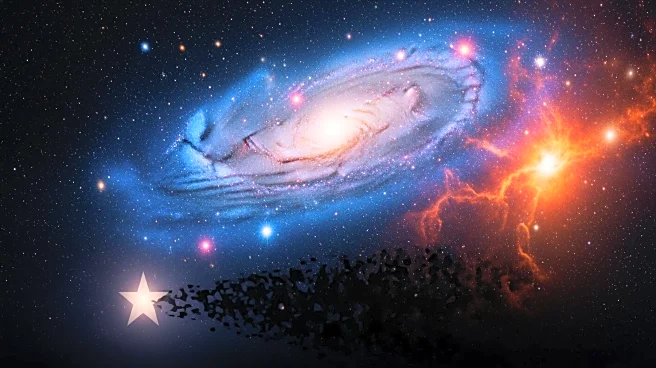
NASA has reported the mysterious disappearance of a massive star in the Fireworks Galaxy (NGC 6946), which was observed by the Hubble Space Telescope. The star, known as N6946-BH1, dramatically increased in brightness in 2009, becoming over a million
times more luminous than the Sun, before vanishing without a trace by 2015. Scientists believe the star underwent a 'failed supernova,' where instead of exploding, its core collapsed into a black hole, leaving no visible remnants. This phenomenon challenges traditional understandings of stellar death, as it suggests some massive stars may end their lives quietly, without the expected supernova explosion.
Why It's Important?
This discovery is crucial for astrophysics as it provides new insights into the life cycle of massive stars and the formation of black holes. Understanding these 'failed supernovae' could help refine models of stellar evolution and black hole formation. The ability of the Hubble Space Telescope to capture long-term changes in the universe is highlighted by this event, underscoring the importance of continuous observation in space research. This finding also contributes to the broader understanding of gravitational forces and the dynamics of black holes.