






What's Happening?
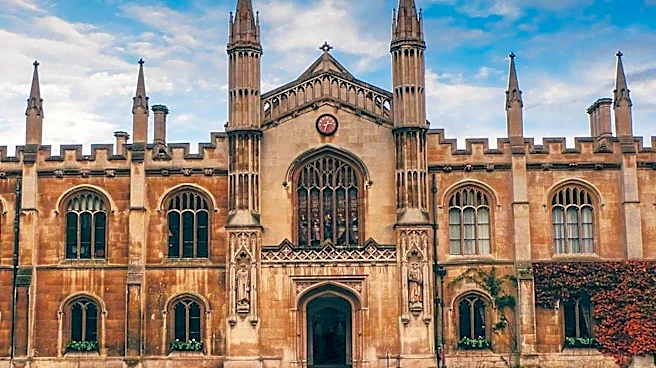
St. John's College, known for its liberal arts curriculum, emphasizes the integral role of music in education and its connection to American identity. The college's approach to music extends beyond performance, delving into its philosophical, mathematical,
and cultural significance. The curriculum explores how music, from Walt Whitman's 'I Hear America Singing' to 'America the Beautiful' and Francis Scott Key's 'The Star-Spangled Banner,' captures the spirit and values of the nation. Students engage with music as a means to understand freedom, self-control, and the rule of law. The college also integrates the study of musical masterpieces, such as Bach's St. Matthew Passion and Mozart's operas, to explore the relationship between music, mathematics, and human emotion. This holistic view positions music not just as an art form but as a fundamental component of intellectual and moral development.
Why It's Important?
The emphasis on music within a rigorous liberal arts framework, as practiced by St. John's College, highlights a critical aspect of education often overlooked in modern curricula: the interdisciplinary nature of knowledge. By connecting music to philosophy, mathematics, and national identity, the college demonstrates how artistic expression can deepen understanding across various fields. This approach is important for U.S. education as it advocates for a more comprehensive and integrated learning experience, fostering critical thinking and a nuanced appreciation for cultural heritage. In an era where STEM fields often dominate educational discourse, St. John's College's model underscores the enduring value of the humanities and arts in cultivating well-rounded citizens capable of engaging with complex societal issues and preserving cultural legacies. It also reinforces the idea that understanding national anthems and patriotic songs goes beyond mere memorization, offering insights into the historical and philosophical underpinnings of American values.
What's Next?
St. John's College will continue to integrate music as a core component of its liberal arts program, with freshmen singing together to learn fundamentals and sophomores delving into the mathematical and theoretical aspects of music. The college's commitment to restoring music as a liberal art suggests ongoing efforts to refine and expand its musical offerings, potentially influencing other educational institutions to adopt similar interdisciplinary approaches. Future discussions within the college community will likely explore how music can further enhance the understanding of complex texts and philosophical concepts. The college's model may also serve as a case study for educators seeking to demonstrate the practical and intellectual benefits of a comprehensive arts education in fostering critical thinking and cultural literacy among students.
Beyond the Headlines
The exploration of music's power to shape character and influence the soul, as discussed in the context of Plato's Republic, delves into profound ethical and psychological dimensions. Socrates' warning about music's potential dangers and its capacity to 'sink down to the inmost soul' raises questions about the responsibility of artists and educators in shaping public consciousness. This perspective suggests that music is not merely entertainment but a potent force with the ability to cultivate virtues or vices. In contemporary U.S. society, where music is ubiquitous and diverse, understanding its ethical implications becomes crucial. This deeper analysis encourages a critical examination of the music we consume and create, prompting reflection on its impact on individual and collective well-being, and its role in transmitting cultural values and shaping societal norms.