



What's Happening?
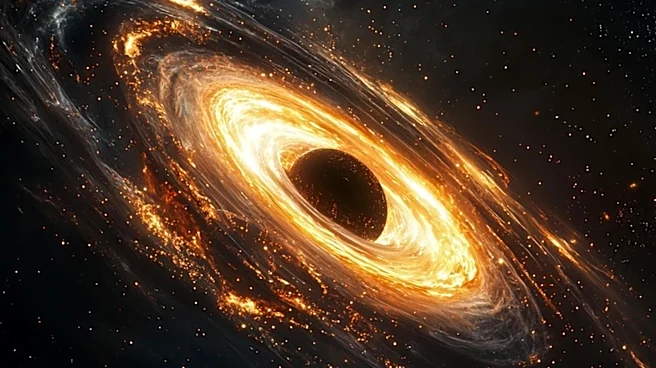
Astronomers have successfully tracked the orbit of a star, known as S2, near the center of the Milky Way, which reaches speeds close to 3 percent of the speed of light. This star orbits around Sagittarius A*, a supermassive black hole that is four million
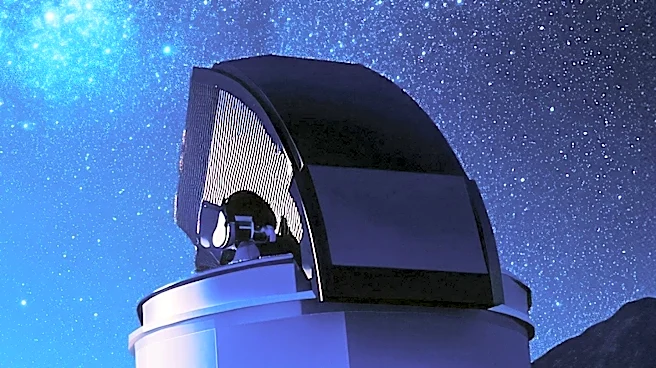
times the mass of the Sun. The tracking of S2's orbit over nearly three decades by teams led by Reinhard Genzel and Andrea Ghez has provided conclusive evidence of the black hole's existence. The observations were made using advanced techniques such as speckle imaging and adaptive optics, which allowed astronomers to overcome atmospheric distortion and achieve high-resolution images. The star's orbit has been instrumental in measuring the mass and gravitational effects of the black hole, confirming predictions made by Einstein's theory of general relativity.
Why It's Important?
The confirmation of a supermassive black hole at the center of the Milky Way has significant implications for our understanding of galaxy formation and evolution. It provides a crucial test of general relativity in a strong gravitational field, offering insights into the behavior of matter and energy in extreme conditions. The discovery also highlights the importance of long-term observational programs in astronomy, demonstrating how patient measurement can lead to groundbreaking scientific achievements. This finding contributes to the broader field of astrophysics by enhancing our knowledge of black holes, which are key components in the dynamics of galaxies and the universe as a whole.
What's Next?
Future research will likely focus on further exploring the properties of Sagittarius A* and its surrounding environment. The Event Horizon Telescope's recent imaging of the black hole's shadow opens new avenues for studying the immediate vicinity of the event horizon. Additionally, astronomers may continue to monitor other stars in the region to refine measurements and test theories of gravity and black hole physics. These efforts will deepen our understanding of the role of supermassive black holes in galaxy centers and their influence on cosmic structures.
Beyond the Headlines
The study of S2's orbit not only confirms the presence of a supermassive black hole but also serves as a testament to the power of collaborative scientific efforts. The work of Genzel and Ghez, recognized by the Nobel Prize, underscores the importance of international cooperation and technological advancements in achieving scientific breakthroughs. This discovery also raises ethical considerations regarding the allocation of resources for long-term scientific projects, emphasizing the need for sustained investment in fundamental research.