
What's Happening?
A recent study published in Science suggests that colossal octopuses may have been the top predators in the Cretaceous seas, challenging the long-held belief that vertebrates like mosasaurs and great sharks
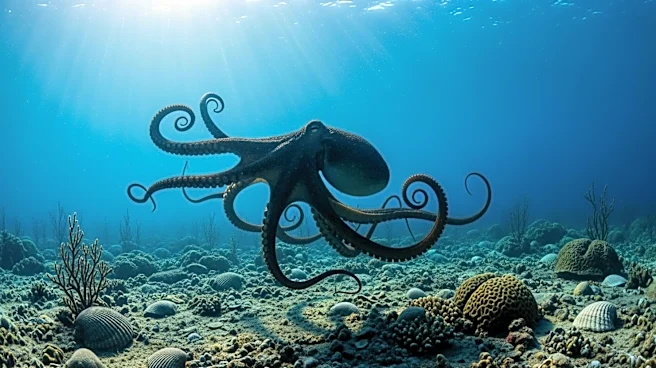
dominated the oceans. The research, led by Shin Ikegami of Hokkaido University, indicates that some octopuses reached lengths of up to 19 meters, allowing them to compete with and possibly prey upon other large marine predators. This finding is based on the analysis of fossilized octopus jaws, which show wear patterns consistent with shell-crushing behavior, suggesting a diet that included hard-shelled invertebrates and possibly vertebrates.
Why It's Important?
This study has significant implications for our understanding of marine ecosystems during the Cretaceous period. It challenges the traditional view of the food chain, where vertebrates are typically seen as apex predators. The idea that invertebrates like octopuses could have been at the top of the predatory hierarchy suggests a more complex and dynamic ecosystem. This research also highlights the evolutionary adaptations of octopuses, such as intelligence and mobility, which may have allowed them to thrive as dominant predators. These findings could lead to a reevaluation of marine life dynamics and evolutionary pathways during the Cretaceous.
Beyond the Headlines
The study raises intriguing questions about the evolutionary pressures that led to the gigantism of octopuses and their role in the marine food web. It also prompts a reconsideration of the ecological interactions between vertebrates and invertebrates, potentially influencing how scientists model ancient ecosystems. Furthermore, the research underscores the importance of fossil evidence in reconstructing past environments and understanding the evolutionary history of marine life.