







What's Happening?
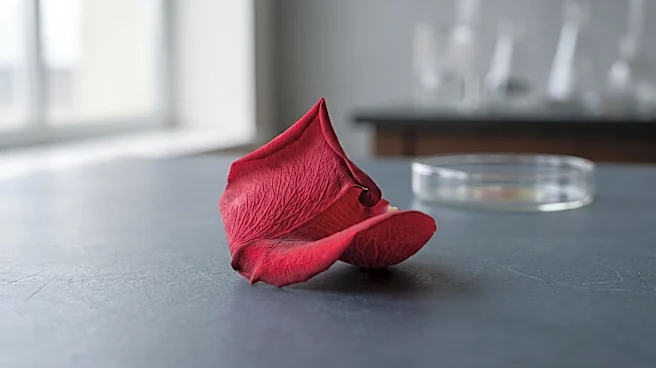
Physicist Eran Sharon's lab at the Hebrew University of Jerusalem has uncovered the unique mathematical reason behind the distinctive curling shape of rose petals. Unlike other flowers whose shapes are often explained by 'Gauss incompatibility'—where
differing growth rates create mechanical stresses—rose petals exhibit a different geometric cause. Sharon's team found that rose petals possess a conical structure that is compatible with a flat geometry, meaning they shouldn't have internal tension from Gauss incompatibility. Instead, their research indicates that rose petals are subject to 'Mainardi-Codazzi-Peterson incompatibility.' This occurs when different parts of a petal attempt to curl in varying ways, leading to tension accumulation at specific points and forming the characteristic pointed edges. This mechanism, previously unobserved in nature, was confirmed through dissections, theoretical models, computer simulations, and experiments with rubber surfaces. The study highlights that while many plant shapes relate to the golden ratio or Fibonacci sequence for optimal sunlight exposure, the rose's unique form is due to a distinct geometric principle.
Why It's Important?
This discovery is significant for several scientific fields, particularly in biophysics, mathematics, and materials science. Understanding the precise geometric and physical principles that govern natural forms, like the rose petal, can lead to advancements in biomimicry—the design and production of materials, structures, and systems that are modeled on biological entities and processes. For instance, insights into how rose petals manage stress and form complex shapes could inform the development of new materials with tailored mechanical properties or self-shaping capabilities. In a broader scientific context, it deepens our understanding of how complex biological structures arise from fundamental physical laws, challenging previous assumptions about universal mechanisms for plant morphology. This research also underscores the intricate mathematical beauty embedded in nature, potentially inspiring new computational models for growth and form in various biological systems.
What's Next?
The findings from Sharon's lab open new avenues for research into geometric incompatibilities in biological systems. Future studies may focus on identifying other natural processes or organisms that exhibit Mainardi-Codazzi-Peterson incompatibility, as rose blossoms are currently the only known example. Researchers might also explore how these unique geometric principles influence other aspects of plant biology, such as water retention, light absorption, or defense mechanisms. The insights could also be applied in engineering, prompting investigations into how these principles can be leveraged to design novel structures or materials with specific curvature and stress distribution properties. Further interdisciplinary collaboration between physicists, mathematicians, and botanists could lead to a more comprehensive understanding of the diverse mechanisms driving biological form and function across the natural world.
Beyond the Headlines
Beyond the immediate scientific implications, this research offers a profound perspective on the complexity and elegance of natural design. It challenges the notion that all natural patterns conform to a few well-known mathematical sequences, revealing a deeper, more varied set of physical laws at play. This understanding can foster a greater appreciation for the intricate details of the natural world, moving beyond superficial aesthetics to a scientific admiration of form. Ethically, such discoveries reinforce the value of fundamental research, demonstrating how curiosity-driven inquiry into seemingly simple phenomena can yield groundbreaking insights. Culturally, it bridges the gap between art and science, showing that the beauty of a rose is not just in its appearance but also in the sophisticated mathematical principles that govern its very structure, echoing physicist Richard Feynman's view that scientific inquiry only adds to the awe of a flower.