





What's Happening?
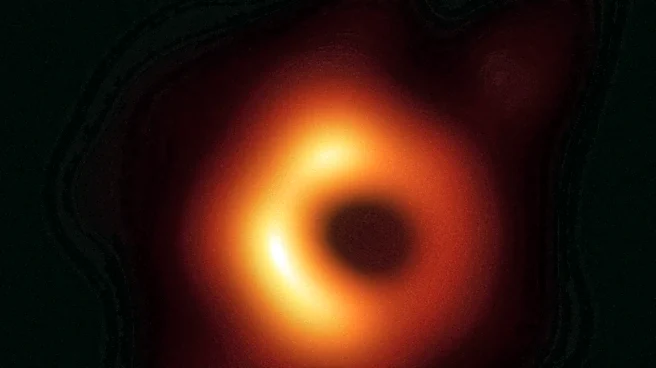
A new, independent re-analysis of data from the Event Horizon Telescope (EHT) has confirmed the iconic ring structure of the M87* black hole, originally imaged in 2019. This re-analysis, conducted by a research team led by Samuel Lai of Australia's Commonwealth
Scientific and Industrial Research Organisation (CSIRO), utilized an original image-reconstruction method combining 'closure invariants' with generative AI. The study, published in Nature on November 11, 2026, stably reproduced a ring structure approximately 42 microarcseconds in diameter, consistent with the initial EHT findings. This confirmation addresses previous skepticism regarding the image's reliance on specific processing methods and reinforces the accuracy of general relativity in describing spacetime around black holes.
Why It's Important?
The confirmation of M87*'s ring shape is a significant validation for the theory of general relativity, as the ring is a direct consequence of how light bends in the presence of an extremely massive object. The EHT's initial image was a historic visual confirmation of black holes, but the complex computational reconstruction from sparse data led to some debate about its fidelity. This independent re-analysis, using a different methodology less susceptible to instrument calibration errors and initial image assumptions, strengthens the scientific community's confidence in the original findings. It demonstrates the robustness of the observation and the underlying physics, solidifying our understanding of black hole characteristics and their interaction with light.
What's Next?
While the ring's existence and diameter are now more firmly established, uncertainties remain regarding finer details such as the ring's width, the darkness of its center, and the black hole's spin. Future research will focus on uncovering these details with improved observational resolution and by verifying theoretical models. The team's analysis also estimated M87*'s mass at approximately 6.5 billion times that of the Sun, aligning with stellar motion measurements and reconfirming the EHT's 2019 mass estimate. This robust confirmation of the basic shape of M87* paves the way for more detailed investigations into the structure of spacetime and the dynamics of accretion flows around black holes, potentially through advancements like space-based Very Long Baseline Interferometry (VLBI).