







What's Happening?
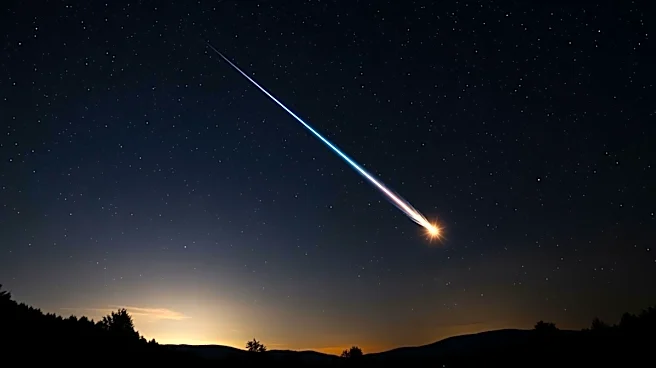
Comet PanSTARRS, officially known as Comet C/2025 R3, is set to make its closest approach to Earth on April 26, traveling approximately 45 million miles from the planet. Having recently survived its closest pass to the sun on April 19, the comet is now visible
through the Large Angle and Spectrometric Coronagraph (LASCO) instrument on the Solar and Heliospheric Observatory spacecraft. This provides a unique opportunity to observe the comet's journey as it moves through the field of view of the sun-facing instrument. The comet is currently visible from the southern hemisphere and has a brightness magnitude of around +4.5, making it visible to the naked eye as a hazy patch of light.
Why It's Important?
The approach of Comet PanSTARRS offers a rare opportunity for both professional astronomers and amateur stargazers to observe a celestial event. The comet's visibility through instruments like LASCO allows for detailed study of its composition and behavior as it interacts with solar radiation. This event also highlights the capabilities of space observatories in tracking and studying objects within our solar system, contributing to our understanding of cometary dynamics and solar system evolution. The public interest in such events can also inspire educational initiatives and increase awareness of space science.
What's Next?
As Comet PanSTARRS continues its journey, astronomers will likely conduct further observations to gather data on its trajectory and physical characteristics. The comet's path will be closely monitored by space agencies, and additional imagery will be made available through platforms like the NOAA Space Weather Prediction Center. This ongoing observation will help refine models of comet behavior and contribute to future predictions of similar celestial events.