
What's Happening?
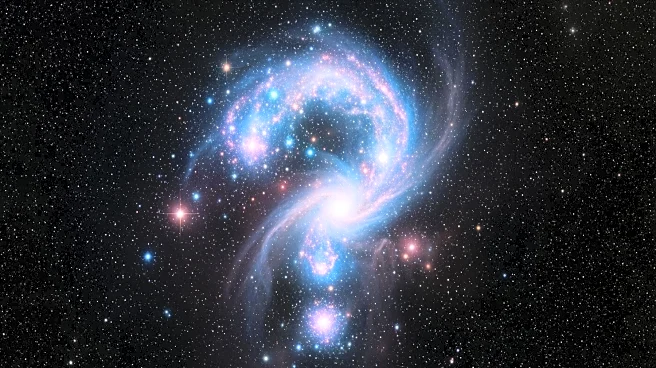
NASA's James Webb Space Telescope (JWST) has captured a striking image of a distant galaxy forming a structure resembling a question mark. This phenomenon, observed in a study published by NASA, highlights
the dynamic processes involved in galaxy formation and evolution. The peculiar shape is the result of two galaxies merging, a common occurrence in the universe. These mergers cause gravitational distortions, leading to unique visual formations. The image, initially focused on a pair of stars, gained attention due to the unusual shape of the galaxy, illustrating the power of cosmic forces in shaping galaxies.
Why It's Important?
The discovery of the 'cosmic question mark' provides valuable insights into the mechanisms of galaxy formation and the forces that shape the universe. Galaxy mergers, like the one observed, are crucial events that contribute to the growth and transformation of galaxies over billions of years. Understanding these processes helps astronomers learn more about the evolution of galaxies and the formation of stars. The study of such phenomena is essential for comprehending the larger cosmic forces at play and the history of the universe, offering a clearer picture of how galaxies and stars, including those similar to our Sun, are created.
What's Next?
Future observations by the James Webb Space Telescope and other astronomical instruments will continue to explore similar cosmic phenomena. By studying young stellar objects and galaxy mergers, scientists aim to deepen their understanding of star formation and galaxy evolution. The ongoing research will focus on identifying more such structures and analyzing the role of gravitational lensing in creating visual distortions. These efforts will enhance our knowledge of the universe's history and the processes that govern cosmic evolution.
Beyond the Headlines
The observation of the cosmic question mark also underscores the importance of advanced telescopes like the JWST in unveiling the universe's hidden aspects. The telescope's ability to observe in infrared light allows astronomers to see objects that are too distant or faint for visible light, providing a new perspective on the universe. This capability is crucial for studying the oldest galaxies and understanding the origins of the universe, revealing how galaxies, stars, and the building blocks of life began to form.