




What's Happening?
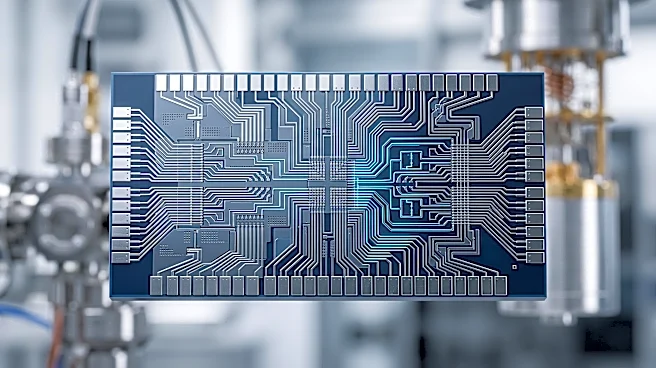
Moth Quantum has announced that its Tessa technique has achieved a quantum computing record by successfully storing and retrieving a significant amount of quantum data on IBM processors. The method involved placing 1,568 numerical values onto IBM’s 120-qubit
Phoenix processor and subsequently using the recovered data to reconstruct an image. This advancement addresses a critical challenge in quantum computing: efficiently transferring ordinary information to quantum machines and retrieving it without substantial loss of accuracy. Previous efforts in this area had recovered only 128 numerical values using 12 trapped-ion qubits, making Tessa's achievement considerably larger in scale. The Tessa technique optimizes the use of the chip's capabilities by employing neighboring qubits for data storage, relying on existing processor connections to avoid extra qubit-moving operations and helper qubits.
Why It's Important?
This breakthrough by Moth Quantum has significant implications for the U.S. technology sector, particularly in the burgeoning field of quantum computing. The ability to store and retrieve larger datasets on quantum processors more efficiently could accelerate the development of quantum machine learning and other quantum applications. Overcoming the data input bottleneck is crucial for unlocking the full potential of quantum computers, which could lead to advancements in various industries, including finance, healthcare, and materials science. U.S. companies and research institutions investing in quantum technology stand to gain from improved data handling capabilities, potentially leading to faster innovation and a competitive edge in the global quantum race. While current recovery percentages for biological data are not yet suitable for dependable medical applications, the progress in data storage and retrieval is a foundational step towards future practical uses.
What's Next?
Future efforts will likely focus on improving the accuracy of data recovery and addressing the inherent inaccuracies observed in current quantum hardware. The study noted that Phoenix's brightness error was 2.6 times higher than predicted, indicating a need for further hardware refinement. Additionally, the Tessa technique currently depends on a specific pattern of qubit connections, and measurement demands increase sharply with more connections, suggesting areas for optimization. Researchers will also need to develop and integrate error-correction techniques, which were not used in the reported hardware experiments, to enhance the reliability of quantum data processing. Continued research into representing diverse information types, such as DNA and protein sequences, with higher fidelity will be essential for expanding the practical applications of quantum computing in fields like biotechnology and medicine.
Beyond the Headlines
The development of techniques like Tessa highlights a broader shift in the technological landscape, where the ability to bridge classical and quantum computing environments becomes increasingly vital. This advancement could trigger a re-evaluation of data processing strategies across various industries, pushing for hybrid solutions that leverage the strengths of both classical and quantum systems. Ethical considerations regarding the security and integrity of data stored and processed on quantum machines will also become more prominent as these technologies mature. Furthermore, the need for specialized expertise in quantum information science will grow, influencing educational curricula and workforce development in the U.S. The long-term impact could be a fundamental transformation in how complex data problems are approached, leading to unprecedented computational power for scientific discovery and technological innovation.