
What's Happening?
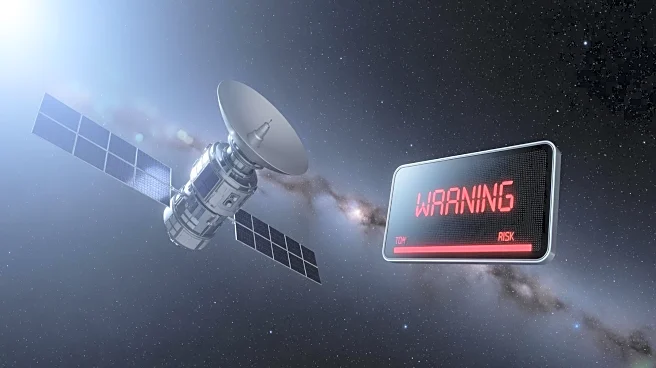
Princeton University graduate student Sarah Thiele and her team have developed a new tool called the Collision Realization And Significant Harm (CRASH) Clock to measure the risk of catastrophic satellite
collisions. The CRASH Clock currently indicates that a major collision could occur in just 5.5 days if satellite operators lose the ability to perform avoidance maneuvers. This development highlights the increasing danger posed by the growing number of satellites in orbit, particularly with the proliferation of SpaceX's Starlink satellites. The concept of Kessler Syndrome, first introduced by NASA researcher Donald Kessler in 1978, describes a scenario where one satellite collision triggers a chain reaction, potentially leading to the loss of all satellites. The CRASH Clock serves as a stark warning of how close we are to such a scenario, with the risk having escalated significantly in recent years.
Why It's Important?
The potential for a catastrophic satellite collision poses a significant threat to global communications, navigation, and various other systems that rely on satellite technology. A major collision could disrupt international communications, halt transportation, and collapse global supply chains. The rapid increase in the number of satellites, especially from megaconstellations like Starlink, has heightened the risk of collisions. This situation underscores the need for improved satellite management and collision avoidance strategies. The CRASH Clock's alarming prediction of a collision within days highlights the urgency for satellite operators and policymakers to address this growing threat to ensure the continued functionality of critical satellite-dependent services.
What's Next?
In response to the heightened risk of satellite collisions, satellite operators may need to enhance their collision avoidance protocols and invest in more advanced technologies to maintain control over their satellites. Policymakers and international space agencies might consider implementing stricter regulations on satellite launches and developing collaborative strategies to manage space traffic. Additionally, research into alternative methods for satellite deorbiting and debris mitigation could become a priority to prevent the exacerbation of the Kessler Syndrome scenario. The situation calls for immediate action to safeguard the future of satellite operations and the services they support.