




What's Happening?
Anduril Industries has been awarded a $65 million delivery order by the U.S. Army to supply hardware and mission shelters for its Tactical Intelligence Targeting Access Node (TITAN) program. This contract marks a significant step in transitioning TITAN from
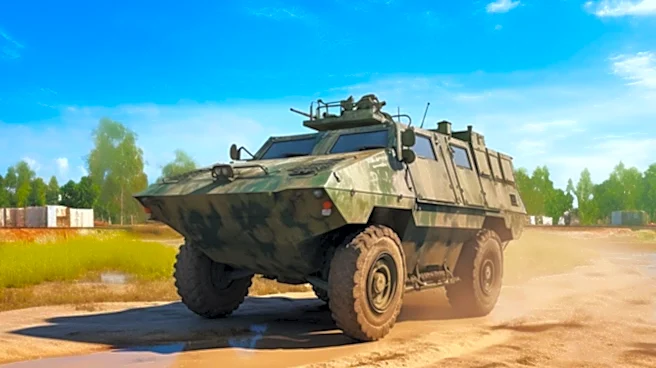
its prototype phase to production. Anduril will be responsible for manufacturing and integrating ruggedized, vehicle-mounted components and operator subsystems for eight TITAN units. These units will include four 'Advanced' variants, featuring higher processing and integration capabilities, and four 'Basic' variants, designed for enhanced mobility and rapid deployment in field conditions. The TITAN system aims to provide frontline Army units with the ability to process and fuse data from various sources, including satellites, aircraft, and ground sensors, to deliver a common intelligence picture directly to combat units in austere environments. This capability is intended to support real-time targeting and rapid strike operations by offering mobile, on-the-move data fusion, a departure from traditional multi-source data integration that typically requires large, stationary infrastructure.
Why It's Important?
This contract is crucial for the U.S. Army's modernization efforts, particularly in enhancing its intelligence, surveillance, and reconnaissance (ISR) capabilities. The TITAN program addresses a critical need for mobile, integrated intelligence processing at the tactical edge, which is vital for maintaining an advantage in complex operational environments. By enabling frontline units to access and fuse multi-source data in real-time, TITAN can significantly improve situational awareness, accelerate decision-making, and facilitate more precise and rapid strike operations. This development has substantial implications for military doctrine, emphasizing distributed intelligence and agile command and control. For the defense technology sector, it underscores the growing demand for advanced, AI-driven solutions that can operate effectively in challenging conditions. Anduril's role in this program highlights the increasing importance of private sector innovation in delivering cutting-edge capabilities to the U.S. military, potentially setting a precedent for future defense acquisitions and partnerships.
What's Next?
Anduril Industries will proceed with manufacturing the hardware at its facility in Costa Mesa, California, and integrating the necessary power, environmental control, and operator systems for the TITAN units. The company has been involved in the program since 2021, acting as the lead hardware systems architect and incorporating soldier feedback during design and testing. With the Army planning additional TITAN orders in the 2027 fiscal year, Anduril is preparing to scale up its production capabilities to meet future demand. Palantir Technologies leads the overall TITAN program team, indicating a collaborative effort in developing and deploying this critical system. The successful deployment of these initial eight TITAN units will likely inform future iterations and broader adoption across the Army, potentially leading to further contracts and expanded capabilities for the program. This ongoing development signifies a continuous effort to enhance the Army's intelligence infrastructure and operational effectiveness.
Beyond the Headlines
The TITAN program represents a significant leap towards a more interconnected and data-driven battlefield, fundamentally altering how intelligence is gathered, processed, and disseminated. This shift has profound implications for military strategy, moving towards a 'sensor-to-shooter' model where data from diverse sources can be rapidly translated into actionable intelligence for targeting. Ethically, the increased speed and precision of targeting raise questions about accountability and the potential for autonomous decision-making in warfare. The program's emphasis on mobile, distributed intelligence also challenges traditional notions of centralized command, potentially empowering lower-echelon units with unprecedented levels of information. Culturally, it will require significant adaptation within the Army, demanding new skill sets for soldiers to effectively utilize and interpret complex data streams. The long-term impact could be a more agile and responsive military force, but also one that is heavily reliant on advanced technology and resilient against cyber threats to its data networks.