





What's Happening?
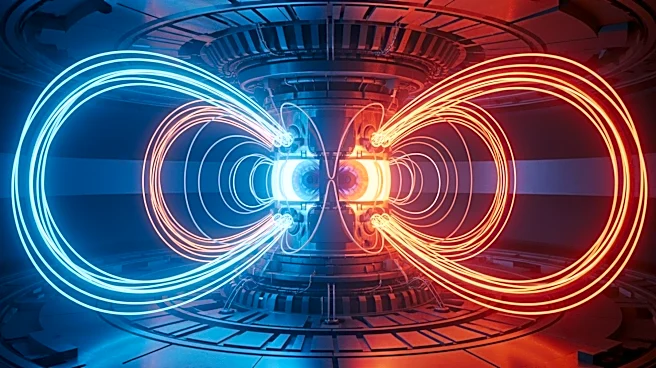
A research team led by Professor Xu Guosheng from the Institute of Plasma Physics, Chinese Academy of Sciences, has achieved a significant milestone in nuclear fusion research. The team demonstrated a plasma regime that maintains stability while reducing
heat loads on divertor plates in a metal-wall environment. This regime, achieved on the EAST tokamak, involves partial divertor detachment and an edge-localized-mode (ELM)-free high-confinement mode. By controlling the injection of light impurity gases, the team was able to sustain this regime for one minute, marking a major step toward stable, long-pulse fusion operation. The research addresses the challenge of managing extreme heat loads while maintaining plasma stability, a key goal in the pursuit of controllable nuclear fusion.
Why It's Important?
The achievement represents a significant advancement in the quest for sustainable nuclear fusion, which has the potential to provide a nearly limitless source of clean energy. By overcoming the challenges of heat load management and plasma stability, this research brings the scientific community closer to realizing practical fusion energy. The implications for energy production are profound, as fusion could significantly reduce reliance on fossil fuels and decrease greenhouse gas emissions. The success of this research could accelerate the development of fusion reactors, offering a viable solution to global energy demands and contributing to efforts to combat climate change.