



What's Happening?
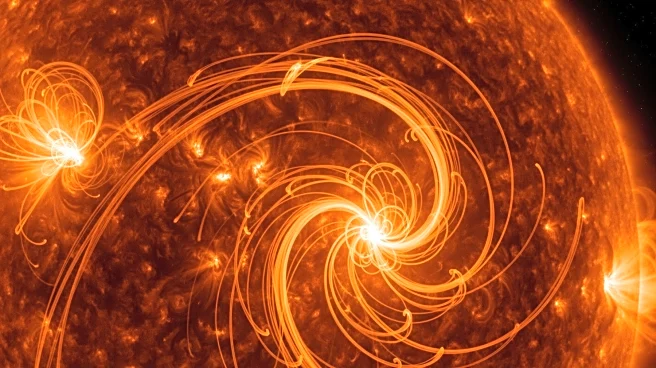
The European Space Agency's Solar Orbiter spacecraft has made a significant discovery regarding the mechanism behind solar flares. During a close approach to the sun on September 30, 2024, the spacecraft observed that solar flares are triggered by initially
weak disturbances that escalate into more violent events, creating a 'sky' of raining plasma blobs. This process, described as a magnetic avalanche, was detailed in a paper published in Astronomy & Astrophysics on January 21, 2026. The observations were made possible by the spacecraft's SPICE and STIX instruments, which provided high-resolution data on the rapid series of reconnection events that deposit energy in the sun's outer atmosphere.
Why It's Important?
Understanding the mechanism behind solar flares is crucial as these powerful explosions can lead to geomagnetic storms on Earth, potentially causing radio blackouts and affecting satellite operations. The discovery of the magnetic avalanche mechanism provides insights into the energy release process of solar flares, which could improve forecasting and mitigation strategies for space weather impacts. This knowledge is vital for protecting technological infrastructure and ensuring the safety of astronauts and satellites in space.
What's Next?
Further research is needed to determine if the magnetic avalanche mechanism is present in all solar flares and on other flaring stars. The findings from the Solar Orbiter could lead to refinements in existing theories of flare energy release, enhancing our understanding of solar and stellar phenomena. Continued observations and data analysis from the Solar Orbiter and other missions will be essential in exploring these processes in greater detail.