




What's Happening?
A research team from the University of California, Los Angeles (UCLA) Department of Physics and Astronomy has published findings in The Astrophysical Journal suggesting a new mechanism for the formation of supermassive black holes in the early universe.
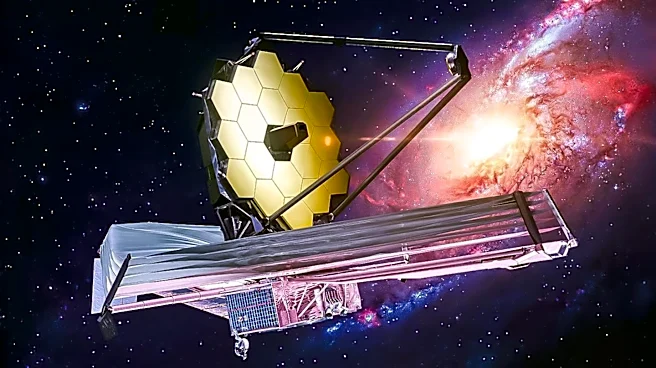
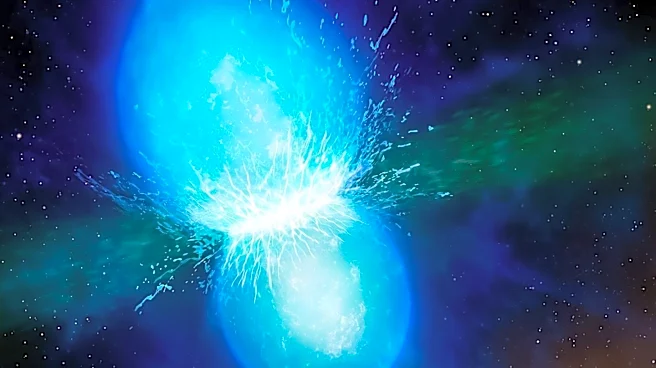
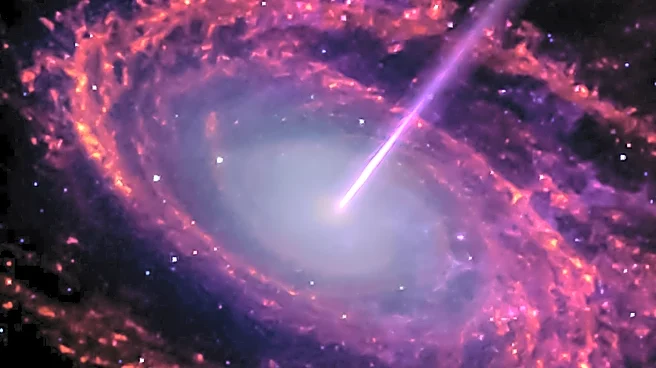
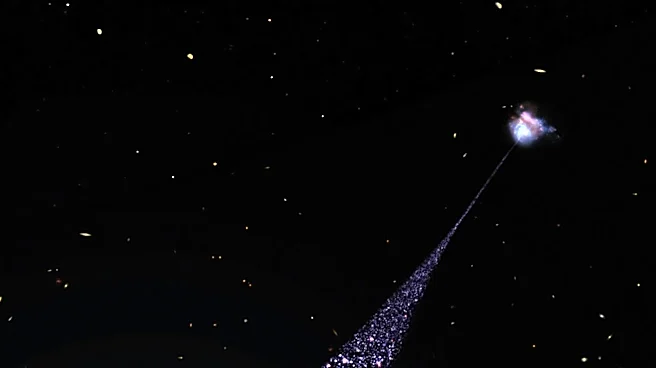
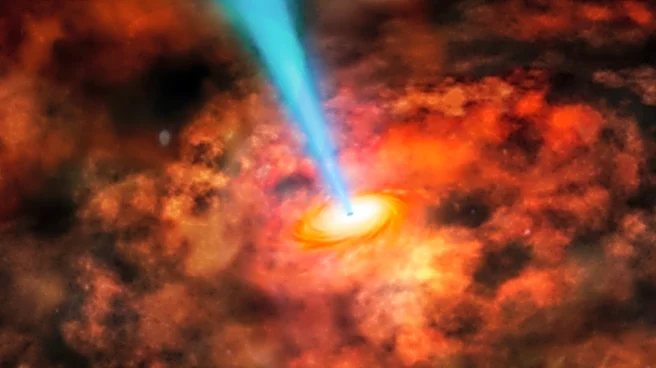
Analyzing observational data from the James Webb Space Telescope (JWST), the team concluded that stars in the early universe, shortly after the Big Bang, were densely packed and frequently collided. These collisions, particularly those occurring at relatively slow speeds, allowed stars to merge. Repeated mergers led to the formation of gigantic stars, which subsequently collapsed under their own gravity to become massive black holes. The study also proposes that rapid stellar collisions near these nascent black holes would destroy stars, creating a high-density gaseous environment that could explain the properties of 'Little Red Dots' (LRDs), unidentified celestial objects observed by the JWST.
Why It's Important?
This research offers a potential solution to the long-standing mystery surrounding the origin of supermassive black holes, which are observed to exist surprisingly early in the universe's history. Understanding how these colossal objects formed so quickly after the Big Bang is crucial for refining cosmological models and our comprehension of galactic evolution. The study's connection between LRDs and ultra-dense star clusters provides a tangible link between theoretical models and observational data, potentially unlocking secrets about these enigmatic early universe objects. The findings could influence future astronomical research, guiding further observations with advanced telescopes like the JWST to confirm or expand upon these proposed mechanisms of black hole formation.
What's Next?
Future research will likely focus on further analyzing JWST data and conducting more detailed simulations to validate the proposed stellar collision and merger scenarios. Astronomers may seek additional observational evidence of LRDs and their characteristics to strengthen the link between these objects and the formation of supermassive black holes. The study's implications could also spur theoretical astrophysicists to refine models of star formation and dynamics in the extremely dense environments of the early universe. Confirmation of this mechanism would provide a significant piece of the puzzle in understanding the universe's evolution and the fundamental processes that shaped its largest structures.
Beyond the Headlines
The UCLA study delves into the fundamental processes that governed the universe in its infancy, offering insights into how the cosmos evolved from a relatively uniform state to the complex structure we observe today. The concept of stars merging to form super-giant stars that then collapse into black holes highlights the extreme conditions and dynamic interactions that characterized the early universe. This research not only advances our understanding of black holes but also underscores the power of modern astronomical instruments like the JWST to peer back in time and reveal previously unseen cosmic phenomena. It touches upon the very origins of cosmic structures, pushing the boundaries of our knowledge about the universe's earliest moments.