




What's Happening?
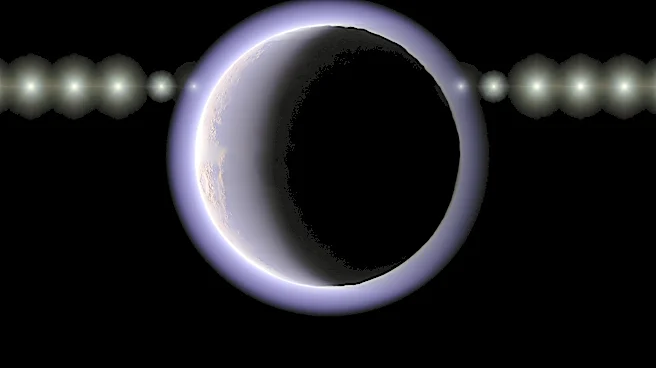
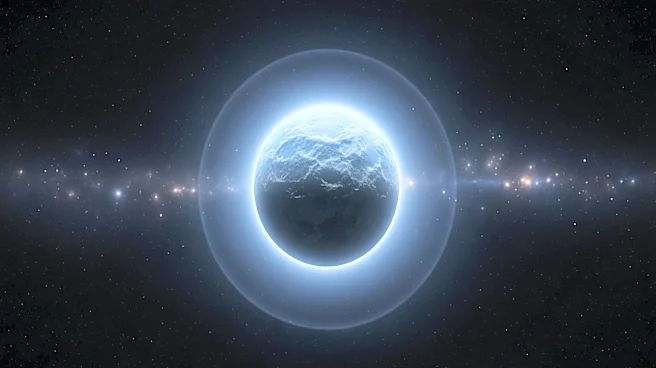
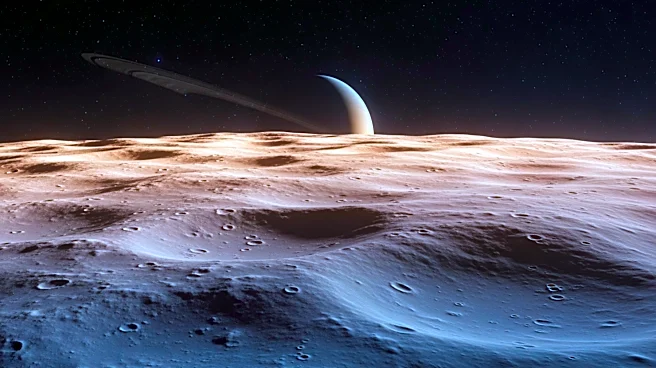
Astronomers have detected a thin atmosphere around a trans-Neptunian object (TNO) known as (612533) 2002 XV93, located in the Kuiper Belt beyond Neptune. This discovery challenges previous assumptions that such small celestial bodies could not retain
atmospheres. The object, with a diameter of approximately 310 miles, has an atmosphere that is 5 million to 10 million times thinner than Earth's and 50 to 100 times thinner than Pluto's. The atmosphere is likely composed of methane, nitrogen, or carbon monoxide. The finding was made by Dr. Ko Arimatsu and his team from the National Astronomical Observatory of Japan, who observed the object during a stellar occultation event, where it passed in front of a star, causing a dimming effect that suggested the presence of an atmosphere.
Why It's Important?
This discovery is significant as it suggests that small icy bodies in the outer solar system may be more dynamic than previously thought. The presence of an atmosphere on such a small object could provide new insights into the processes that allow atmospheres to form and persist in the harsh conditions of the Kuiper Belt. This challenges the conventional view that atmospheres are limited to larger planets and moons. The findings could lead to a reevaluation of the potential for atmospheres on other small celestial bodies in the solar system, impacting our understanding of planetary formation and evolution.
What's Next?
Further observations are needed to confirm the nature and origin of the atmosphere on 2002 XV93. The James Webb Space Telescope is expected to play a crucial role in these future studies, potentially identifying the atmospheric composition and monitoring changes over time. If the atmosphere is found to be stable, it may suggest ongoing internal processes like cryovolcanism. Alternatively, if it fades, it could indicate a temporary atmosphere created by a recent impact event. These observations will help determine whether 2002 XV93 is an anomaly or if similar small objects also possess atmospheres.