





What's Happening?
Texas Republican leaders are advancing efforts to combat alleged 'birth tourism,' even as a federal district court has temporarily blocked President Trump's executive order aimed at restricting the practice nationwide. The federal judge's ruling last
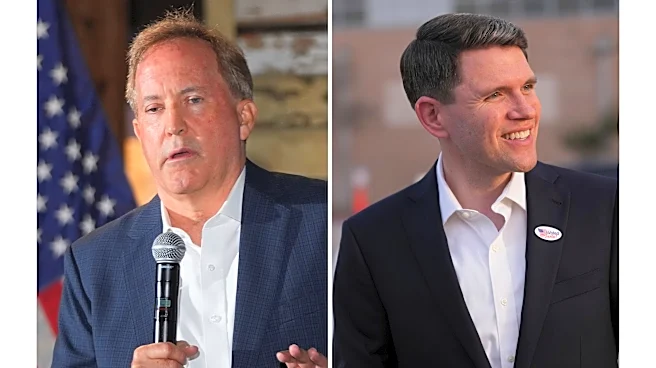
week marked another setback for President Trump's attempts to modify the Citizenship Clause of the Fourteenth Amendment, which grants U.S. citizenship to individuals born in the United States. President Trump's August executive order directed the State Department and Department of Homeland Security to revoke visas and permanently bar noncitizens entering the U.S. for the purpose of giving birth and securing U.S. citizenship for their children. This followed a Supreme Court ruling in June that upheld the Fourteenth Amendment's definition of birthright citizenship, deeming President Trump's initial order unconstitutional. Texas Attorney General Ken Paxton has already filed a lawsuit against a Houston-area care center, alleging it operated as a maternity hotel and violated state laws by encouraging Chinese nationals to seek U.S. citizenship for their children.
Why It's Important?
The ongoing efforts by Texas leaders to crack down on birth tourism, despite federal judicial challenges, highlight a significant legal and political conflict over immigration policy and the interpretation of the Fourteenth Amendment. The federal court's decision to block President Trump's executive order underscores the constitutional protections of birthright citizenship, making it difficult for the administration to unilaterally alter this long-standing principle. For Texas, the focus on state-level enforcement, including investigations by the Texas Health and Human Services Commission and the Attorney General's office, indicates a determination to address perceived abuses of the system. This situation could set precedents for how states navigate federal immigration policies and constitutional interpretations, potentially leading to further legal battles and policy adjustments at both state and national levels. The debate also raises questions about the extent of the birth tourism phenomenon, with some experts suggesting it is a relatively small issue, while others emphasize its potential for exploitation.
What's Next?
The lawsuit filed by Texas Attorney General Ken Paxton against the De'Ai Postpartum Care Center is scheduled for its next hearing in Fort Bend County later this month. Paxton is seeking an injunction to shut down the center, which he claims facilitates numerous births daily. Additionally, Governor Greg Abbott has directed the Texas Health and Human Services Commission to investigate medical centers for allegedly promoting birth tourism packages. These state-level actions will likely continue, potentially leading to more legal challenges and enforcement measures. The federal government, despite the recent court setback, may explore alternative strategies to address birth tourism, possibly through stricter visa application scrutiny or legislative efforts. The effectiveness of these crackdowns will depend on the ability of law enforcement to identify and prosecute transnational networks, which are often sophisticated and difficult to infiltrate.
Beyond the Headlines
The debate surrounding birth tourism extends beyond legal and political arguments, touching upon ethical and societal implications. Critics of birth tourism often cite concerns about national security and the integrity of immigration laws, while proponents emphasize the constitutional right to birthright citizenship and the potential for discrimination. The involvement of transnational networks in facilitating birth tourism raises questions about human smuggling and exploitation, with significant financial incentives driving these operations. The challenge for law enforcement lies in distinguishing between legitimate travel and fraudulent activities, especially when encrypted communication and sophisticated methods are used. This complex issue also highlights the broader discussion about immigration reform, the interpretation of constitutional rights, and the balance between national security and individual liberties in the United States.