



What's Happening?
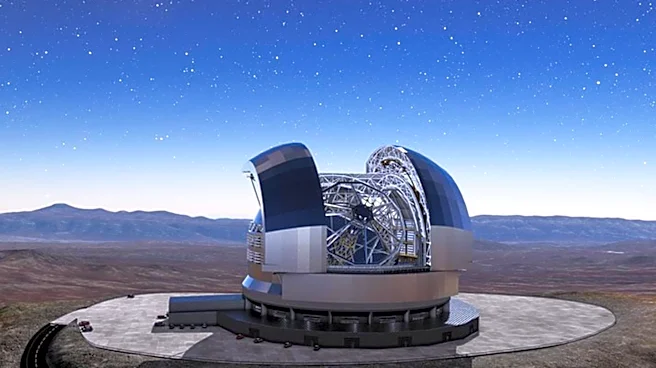
The Vera Rubin Observatory, a major astronomical facility, is poised to make groundbreaking discoveries in the field of astronomy. The observatory is expected to identify over 37,000 trans-Neptunian objects (TNOs) by the mid-2030s, significantly increasing
the current count of about 5,000. It has already discovered 380 TNOs since its test observations began in June 2025. The observatory's wide field of view will also aid in detecting interstellar objects, with the potential to discover new ones beyond the three currently known. Additionally, the observatory is set to discover over five million asteroids and 127,000 near-Earth objects, enhancing our understanding of the solar system.
Why It's Important?
The Vera Rubin Observatory's capabilities will vastly expand our knowledge of the solar system and beyond. By discovering new TNOs and interstellar objects, scientists can gain insights into the formation and evolution of the solar system. The detection of near-Earth objects is crucial for planetary defense, as it helps identify potential threats from space. Furthermore, the observatory's findings could challenge existing theories in cosmology and lead to new scientific paradigms.
What's Next?
As the observatory continues its operations, astronomers will analyze the data collected to identify new celestial bodies and phenomena. The discoveries made by the Vera Rubin Observatory will likely lead to further research and exploration missions, as well as collaborations with other observatories and space agencies. The scientific community will closely monitor the observatory's findings to integrate them into broader astronomical research.