





What's Happening?
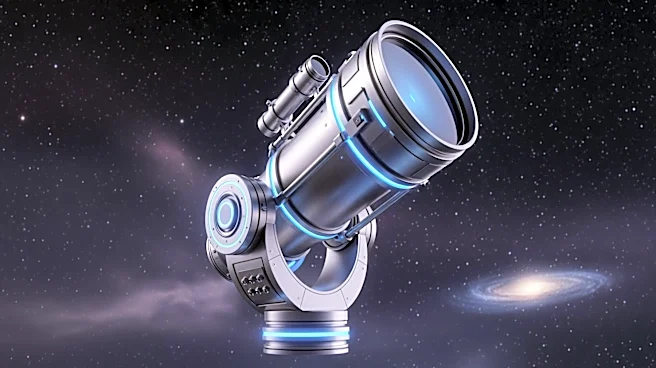
NASA is preparing for the launch of the Nancy Grace Roman Space Telescope, scheduled for August 30, 2026. The telescope is currently being readied at NASA's Goddard Space Flight Center in Maryland and will soon be transported to the Kennedy Space Center in Florida.
Once there, it will undergo final inspections and testing before being integrated with a SpaceX Falcon Heavy rocket. The Roman Space Telescope is designed to survey large areas of the sky with its infrared capabilities, aiming to uncover new stars, galaxies, black holes, and exoplanets. The mission will focus on studying dark energy, dark matter, and other cosmic phenomena, promising to deliver unprecedented views of the universe.
Why It's Important?
The launch of the Roman Space Telescope is significant for the scientific community as it promises to enhance our understanding of the universe. By focusing on dark energy and dark matter, the mission could provide insights into the fundamental forces shaping the cosmos. The telescope's ability to discover new exoplanets and other celestial bodies will expand our knowledge of planetary systems beyond our own. This mission represents a major step forward in space exploration and could lead to breakthroughs in astrophysics and cosmology, potentially influencing future research and technology development.
What's Next?
Following its launch, the Roman Space Telescope will travel to the second Sun-Earth Lagrange point (L2), where it will begin its five-year primary mission. Scientists anticipate a wealth of data from the telescope, which will be used to study a wide range of cosmic phenomena. The mission's success could pave the way for future space telescopes and missions, furthering our exploration of the universe. As the launch date approaches, NASA will continue to provide updates and insights into the preparations and expected outcomes of the mission.