



What's Happening?
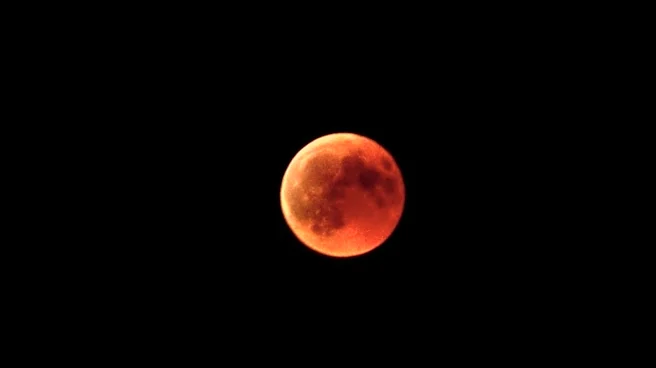
North America is set to experience a significant lunar eclipse on the night of August 27/28, 2026. This event, dubbed a 'Blood Moon' lunar eclipse, will see approximately 96% of the full Moon's surface enter Earth's shadow, causing it to appear in dramatic
copper red or deep orange hues. Unlike a solar eclipse, this lunar phenomenon is entirely safe to observe with the naked eye. The 'greatest eclipse,' when the Moon is most covered, is projected to occur at 04:13 UTC (00:13 EDT). The eclipse will begin in earnest around 02:34 UTC (22:34 EDT). This particular full Moon is known as the Sturgeon Moon, a traditional name for August's full Moon, historically associated with the abundance of sturgeon fish. Observers across the USA and Canada will have the opportunity to witness this celestial event, with specific timings varying by time zone.
Why It's Important?
This upcoming lunar eclipse offers a unique opportunity for public engagement with astronomy and natural phenomena across the United States and Canada. Such events can spark interest in science education and provide a shared cultural experience. For amateur astronomers and the general public, it's a chance to observe a celestial event without specialized equipment, fostering a connection to the cosmos. The visibility of nearly the entire lunar disc turning red or orange is a relatively rare and visually striking occurrence, making it a significant event for sky-watchers. It also serves as a reminder of the predictable yet awe-inspiring mechanics of our solar system, contrasting with the solar eclipse that much of North America missed earlier in the year.
What's Next?
As August 2026 approaches, astronomy enthusiasts and the general public in the USA and Canada can prepare to observe this deep partial lunar eclipse. No special viewing equipment is required, making it accessible to everyone. However, using binoculars or a small telescope can enhance the viewing experience by revealing details of the Moon's surface as it enters and exits Earth's shadow. Observers are advised to find a location away from light pollution for the best visibility, especially as the Moon begins to dim. The further west an observer is located, the more crucial a clear eastern horizon will be, as the Moon may already be eclipsed or just beginning its eclipse as it rises. Local news outlets and astronomy clubs will likely provide more precise viewing times and tips closer to the date.
Beyond the Headlines
Lunar eclipses, particularly those with significant coverage like the one anticipated in August 2026, hold a cultural and historical significance that extends beyond their scientific explanation. Throughout history, such events have been interpreted in various ways, often inspiring myths, legends, and artistic expressions. The 'Blood Moon' phenomenon, with its dramatic coloration, has frequently been associated with omens or prophecies in different cultures. While modern science provides a clear understanding of the mechanics behind a lunar eclipse, its visual impact continues to evoke wonder and contemplation about our place in the universe. This event could also serve as a catalyst for discussions on light pollution and its impact on stargazing, encouraging communities to consider measures to preserve dark skies for future astronomical observations.