








What's Happening?
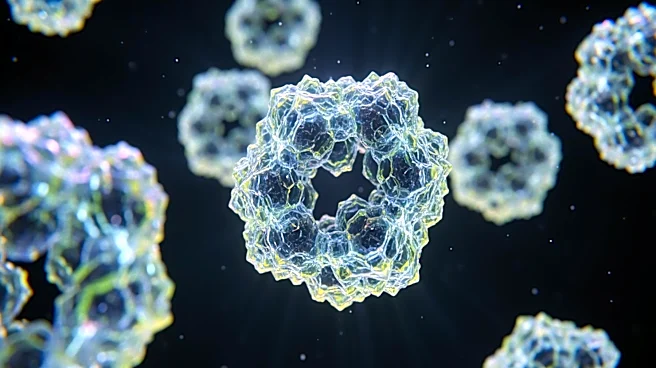
A new hypothesis has been proposed by Prof. Yongdong Jin from Shenzhen University, suggesting that nanozymes played a crucial role in the origin of life on Earth. The 'nanozymes hypothesis' posits that primitive mineral nanozymes, along with organic hybrid
nanozymes, were instrumental in transforming inert chemicals into biologically relevant molecules. This process, described as 'inorganic photosynthesis,' may have occurred under primitive Earth conditions, facilitating the emergence of life. The hypothesis integrates various roles for nanozymes, including catalysis and energy management, and suggests that Earth's natural environments acted as a vast laboratory for these processes. The theory aims to reconcile existing origin-of-life models and provide a comprehensive framework for understanding how life could have emerged from nonliving matter.
Why It's Important?
This new hypothesis offers a potentially unifying explanation for one of science's most enduring mysteries: the origin of life. By suggesting a central role for nanozymes, the theory could bridge gaps between competing models and provide a clearer understanding of the chemical processes that led to life. If validated, this hypothesis could reshape scientific approaches to studying the origin of life, influencing research directions and funding priorities. It also highlights the importance of interdisciplinary research, combining insights from chemistry, biology, and geology to address complex scientific questions.
Beyond the Headlines
The nanozymes hypothesis not only addresses the origin of life but also raises questions about the broader implications of nanozymes in current biological and environmental processes. Understanding the role of nanozymes could lead to advancements in biotechnology and environmental science, potentially offering new methods for catalysis and energy conversion. Additionally, the hypothesis underscores the significance of Earth's natural environments in facilitating complex chemical reactions, which could inform future explorations of life on other planets.